Cryptocurrency and Buddhism are two of my favourite topics currently so you can imagine how my interest was piqued when I came across a news article stating the two had paired in the virtual world.
The cryptocurrency world is still very much a niche one and if your only experience coming across the terms crypto, Bitcoin and NFTs is through traditional media then let me quickly explain what it’s all about.
First we need to start with the term blockchain. Blockchain is a relatively new digital technology designed to act as a ledger recording the movement of money to and from accounts registered on that ledger. In effect it replaces the ledger of a bank bringing it out into the open allowing anyone to read it, should they wish to do so, thereby technically (literally) removing the capacity of dodgy actors from amending the ledger for their own nefarious intentions. In a nutshell, it’s a ledger that removes human naughtiness. There are various types of blockchain out there with differing capabilities and capacities but all built upon that core concept.
NFTs (non-fungible tokens; ie, non-identical tokens) are an asset that have been built onto the blockchain to prove ownership of that asset. So for example, should a person wish to sell their house they could cut out the middle-man and create a contract/title deed on the blockchain ledger. This entry onto the blockchain as already stated, cannot be tampered with and would show very clearly the person whom originally owned it, how much they were paid to sell the house and who has become the new owner, for this reason there is no way the new ownership can be disputed. This new technology certainly has pitfalls but the intention is to avoid scams and fraud and provide a tidy trail of transactions and proof of ownership that everyone can see. In fact, the likes of Rolex are currently onboarding this technology so that on purchase of your brand new Rolex you can check on the blockchain that it is legitimate and not a fake. There even has been talk of trying to quantify Earth’s resources (animals and fish included) and put them on the blockchain in an attempt to provide more sustainable usage of resources and conservation.
Such radical changes can elicit strong reactions from our egos as we look to categorise if the change is beneficial or catastrophic but the truth is we cannot possibly know the future of the path, we can only know the present moment. So, good? Bad? Who knows? Here is a great, old Chinese story of unknown origin to illustrate this.
A farmer used a horse to farm his fields. One day, the horse ran away into the hills. The farmer’s neighbours sympathised with the old man over his bad luck, with the farmer replying, “Bad luck? Good luck? Who knows?”
A week later, the horse returned with a herd of wild horses from the hills, and this time the neighbours congratulated the farmer on his good luck. He replied, “Good luck? Bad luck? Who knows?”
Then, when the farmer’s son was attempting to tame one of the wild horses he fell off and broke his leg. Everyone again sympathized with the farmer over his bad luck. But the farmer’s reaction was, “Bad luck? Good luck? Who knows?”
War broke out in the country and some weeks later, the army marched into the village to draft every able-bodied youth they could find. When they saw the farmer’s son with his broken leg, they let him stay.
Good luck? Bad luck? Who knows?
Hopefully you’re still with me as I lead you onto how NFTs have met with Buddhism
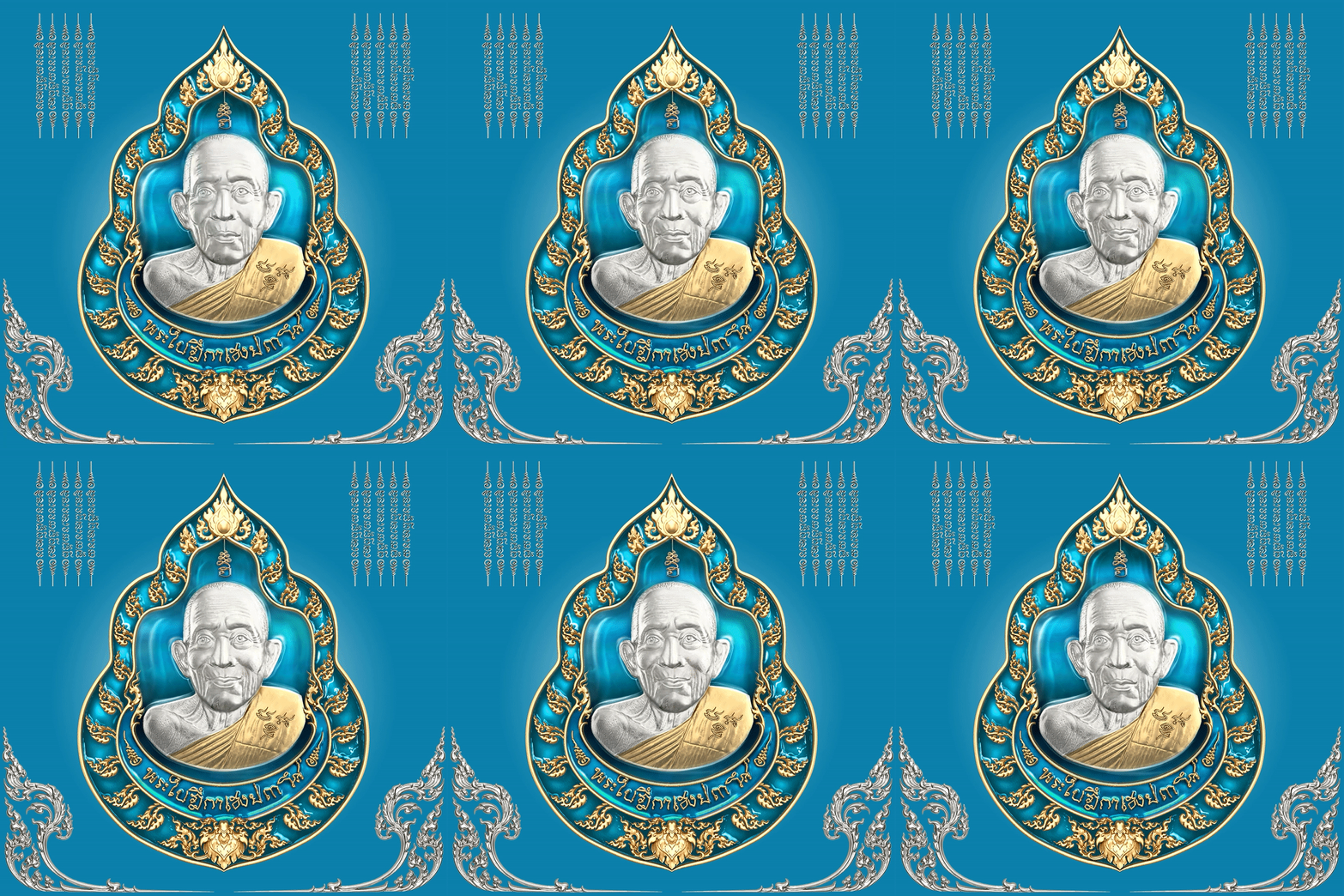
It was reported, only a couple of months ago, that a new type of digital, Buddhist amulet would be making its mark on the NFT space of the crypto world; the first of its kind.
After being approached by a Thai entrepreneurial business, Luang Pu Heng, a 95-year old monk from Thailand’s Surin Province agreed to create and bless digital, NFT amulets for the company, adding some of his own written blessings and chants before they were uploaded onto the Ethereum blockchain and put up to auction online. There are only 8000 of these amulets available to buy, ranging from a price of 0.02 – 0.8 Ethereum (at the time of writing this is equivalent to $46 – $1870) with varying characteristics and of differing rarities, just like you would see in physical amulets. There won’t have been any exchange of money in the creation of these amulets as Buddhist monastics do not handle money but it can be seen from the website, CryptoAmulets.io that 18% of proceeds will be donated to temples in Surin, ventilators for the hospitals and assistance to those in need.
Thai Buddhist amulets are a type of blessed item made from a range of differing materials, that can offer protection, luck and other types of blessings and chants to enhance your life. The amulets can act as a source of income for a monastery to look after the monks and bhikkunis and ensure the survival of the monastery, yet more importantly than that, it’s a way of transferring the pure, loving energy of the Buddhist monastics to the lay people. In addition to this, the Thai wording written on the amulet has been done so by Luang Pu Heng himself who has clearly, very openly taken this new technology in his stride, setting an example that change is nothing to be feared and something only to be adapted to. There is another angle to this too that is of interest to me and that is the difference of having a physical amulet compared to a digital one. The chanting and blessings made by the monastics transfer a physical resonance to the amulet which you in turn are then exposed to by carrying it with you or placing on the dashboard of your car, for example. This resonance will be of a higher frequency due to the purity of the being who has conducted the blessing thereby bestowing good fortune to the holder. So the thought of having the resonance of the digital amulet very much “living” in your smartphone, and with most of your daily life existing as processes on your smartphone, I can’t think of a better thing to exist in it than the energy of a Buddhist monk. Perhaps it can create more lucky opportunities for those applying for jobs on their phone, whilst warding off scam callers!
Our world is changing rapidly at the moment, from the climate to society, to technology. Some of these changes are frightening, taking us away from the knowledge we have from our most recent ancestors and early-life education and can lead us to thought processes of “it shouldn’t be like this” or, “if we were to do [x], then we could return to [y]” and no doubt leaves you in a state of uneasiness and fear. What I have found to be true, and in keeping with the Daoist philosophy of abiding in nature and the Buddhist philosophy of staying with the present moment, is that there is no space for the ‘shoulda-coulda-wouldas’ only a peaceful existence of what is. This approach has helped me more readily accept the changes to our digital technology evolution, having shied away myself from smartphones and social media.
There is much I haven’t commented on in regards to the actual attainment of these NFT amulets and how they are still only really available to those of you who know how to navigate the cryptocurrency space. However, if you were interested in purchasing one yourself and need assistance with the steps please reach out and I’ll be happy to help. (Disclaimer: This is *not* a sponsored post, I have no affiliation with the company, I am not a financial advisor and I don’t own an amulet myself more so due to a lack of funds! Make sure you do your own research before making any purchases, as with anything!)
For me though, I personally love the smiling monk looking back at me from the screen and I find a smile crossing my face too and this experience is evidence enough to me that there is something beautiful in this creation.
If you enjoyed this blog then please click the “Like” button, share it with your friends and drop a comment below whether you would purchase a digital amulet versus a physical one. Thank you as always for taking the time to read my blog, I appreciate each and every one of you.


 TheForceOfDao
Leave a comment