Category: Philosophy & Reflective Thinking

  • “They Pushed Me Away”, and Other Disturbing Beliefs.

    “They Pushed Me Away”, and Other Disturbing Beliefs.

    When a thought hurts, that’s the signal that it isn’t true. – Byron Katie

    You’ve just had an argument with a loved one. They’ve said or done something that you vehemently believe pushed you away. You feel so upset that they would hurt you like that. Why won’t they let you close?

    Perhaps this sounds familiar.

    You’ll hear people advise others on hearing such a story, that he/she “pushed you away”, and you believe it. You feel powerless. How are you ever going to reach them? It feels like a gulf between you two.

    But!

    Have you ever considered that this interpretation is a complete fabrication? That you’ve simply believed this judgement only because others have told you that is what’s happening without ever having questioned it for yourself. What does it even mean when someone pushes you away – is it even possible?

    So for just for a moment let’s consider another possibility. Perhaps there’s another perspective, an opposite to the original belief.

    If you find this resonates with you, I encourage you to follow along with your own scenario where you believed this thought and see what arises for you through gentle inquiry.

    How do you react?

    What happens when you believe the thought, “they pushed me away”?

    If I put myself in the shoes of someone who believes the thought, I would see the other as the “problem”. I believe they are rejecting me, and it feels so painful. They are the one making it difficult to connect. I’m wanting them to be different from what they are, and my thoughts take on a need to change them in order for me to feel connected to them. I criticise their faults in my mind and use that as ammo to prove the belief is true.

    I pull away from them, making myself the victim. I don’t want to express my own vulnerabilities around a person that’s hostile. Comparisons arise in the mind where “I” am better than “them” because they are the aggressor, and I’m the victim. I don’t see my own role in the exchange.

    I feel anxiety in my chest, a constriction in breathing, and the fear of not being close to this person.

    Who would you be without the thought?

    This is an invitation to see who you would be in the same situation without the thought. What might you say or do that is different? This is not intended as an intellectual exercise to change how you behave next time, only simple inquiry.

    Without the thought, I would see someone who is unable to express their emotional state with clarity in that moment. I feel compassion towards them, which immediately brings me closer. I’m aware I’m not actually too sure what it is they’re going through, so I notice curiosity arising in me. Rather than assuming I know what’s going on, I question what’s happening. I feel it’s possible to ask whether I’ve understood them correctly but sharing what I understood them to say. I don’t feel so threatened by their words and behaviour, I can feel more space in my own mind to hold what’s going on for us both. It feels more peaceful this way.

    Rather than rejected, I feel connected.

    Turnarounds

    The turnarounds are a way of exploring whether the opposite is as true as, or truer than the original statement. It is not intended to disqualify the original statement, simply an invitation to try on a different pair of shoes and to see if there’s any truth in it. Such an inquiry can provide profound insights into how beliefs shape our entire world view.

    They didn’t push me away

    I might have interpreted it that way, but I can not know what is going on in their mind. It’s a form of violence to infer intention onto their behaviour. If anything, it causes them to push back.

    It is actually impossible for another person to push me away, only I can believe that onto their behaviour. It is a choice from my side to “be pushed away.”

    It could be that they are hurting and don’t have the emotional intelligence and capacity to express themselves clearly in that moment. What’s more likely is that their behaviour is a cry for connection and love but unable to express it.

    I pushed me away

    I pushed myself away by believing my own thoughts around the intention of their behaviour. I hurt myself in the process and ended up feeling rejected.

    I created distance between myself and the other by interpreting them as the aggressor. I closed down my heart and put up defences to protect myself against the perceived threat.

    All of this takes me away from the present and from the inherent goodness that resides within.

    In a way, I pushed myself away from what felt good internally by the beliefs I held in that moment.

    I pushed them away

    It is useful to reflect upon our own behaviour in the scenario, not as a way to become self-critical and self-flagellating but as a way of waking up to our own reactions.

    It could be that in that situation, I push them away by judging their behaviour as hostile and confrontational, inferring intention onto them, thereby creating distance between us.

    My mind may run off into the past, recalling similar situations and projecting into the future that this is how this person is, and will always be. I make them solid and unchangeable.

    When I’m in my mind I am not present with the person before me and I stop listening to what it is they’re trying to communicate to me – I am caught in the stories in my mind.

    I might notice that I am hostile in my own way by no longer engaging with them from a place of care and understanding.

    I check out, deciding that as far as I’m concerned, the conversation is over. That makes it very hard for them to re-connect.

    There’s another turnaround that I will leave for you to investigate, “they didn’t push me away”. How might that be true in that situation? Please leave a comment down below on any interesting insights you’ve had as you followed along.

    The truth is that we all want to feel heard and understood by others, especially loved ones. Sometimes, without realising it, disconnection arises when we infer meaning onto a person/event that is otherwise meaningless. By learning how to inquire into stressful beliefs, one can become more aware of how these beliefs stop us from being present and seeing life with clarity.

    We begin to awake to the dream.

    If you’re enjoying what you’ve read of this series so far, let me know in the comments what common expression or judgement you’d like me to question next.

    Thanks for reading!

  • “Aren’t You Just Running Away From Your Problems?”, and Other Disturbing Beliefs.

    “Aren’t You Just Running Away From Your Problems?”, and Other Disturbing Beliefs.

    I want to do a short series on “those” sayings, the ones that have you doubting your next move and questioning your own agency. The “moving country won’t solve your problems”, “you have to pick a side otherwise you’re supporting the oppressors”, or, “she pushed me away”, or a ironically toxic belief, “he/she is so toxic, I should cut them out of my life”.

    I want to start off the series with a particular stickler for some, “moving country won’t solve your problems – you’re just running away”. One that has been a pain point for me at times in the past.

    If you’ve ever believed that thought, how does it leave you feeling?

    I know for myself if I think back to a situation where I considered moving country and I believed that thought, I would break out in a nervous panic so afraid that I was getting life “so wrong”. How was it that others were seeing that I was avoiding my problems whereas I was seeing that I was trying to save myself – how could I be so mistaken? Why was I not allowed to save myself? I began to doubt my entire way of Being, how could I now trust myself in anything?

    What ended up happening was that I became stuck in a limbo, unable to take action, so afraid that others would now judge me to be someone who couldn’t face difficulties in their life. Not only that but I wanted people to admire that I was someone who faced difficulties head on and didn’t “give up” (that will be a belief to investigate at another time).

    It was too shameful to leave.

    I developed anger towards myself for being in the situation I was in and not being able to escape it. The anger actually a deep fear of never being able to leave – I created my own prison cell without realising it, stuck in a shadowland.

    The belief didn’t serve me, all it offered was stress. I can see that by believing it I was avoiding taking responsibility for my life. Not in a way that was conscious but in a way that taking a stand for myself and to buck the trend was too scary to even comprehend. If I first checked with others, whether that be with people in person, or seeking advice online, I presumed they knew better than I. I put down my own intuition and experience in favour of those who had never spent a day in my shoes. I truly believed they were right and that everything within me was inherently wrong.

    It became an internal battle of debating the pros and cons and I could feel a wall of worry build up that action needed to be taken but I was stuck in analysis paralysis. Thinking, thinking, thinking.


    Much has changed since those days. I took up a Buddhist practice, meditation and “The Work”, and with it more awareness now surrounds the stories whirling through the mind as it attempts to understand, and bring meaning to the world.

    Bringing awareness to stressful thoughts allows me to see more clearly how I interact with the world through that belief. I’m not interested in changing how I behave so much as simply being aware of what’s going on, waking up to the dream.

    If I put myself back in that past situation and just consider who I would be without the thought that “moving countries won’t solve my problems”, I am back to trusting the direction that I am headed, to trusting myself and noticing what feels intuitively “right” for me in that moment. I feel a little more confident that I can trust that the situation I am in is not serving me, not nourishing my growth or enabling a peaceful state of mind.

    I don’t feel anxious about being judged by others for moving. Their judgement is only based on their perspective of my situation, of which they will never have the full story. Rather than being in the business of others, trying to work out if they approve of me or not and behaving in a way that I think will make my actions worthy of appraisal, I’m back in my business – the only place where I can ever feel peace and joy. I can choose to welcome other’s judgement of my actions as a point of self-reflection and, I can also use their judgement as a way of strengthening my own resolve and trust in my intuition. It’s very likely that someone judging another as “moving on and running away from their problems” is struggling with the same beliefs in their own life and is deserving of compassion as much as myself.

    I don’t feel a fear of what comes next and there is no longer a weighing up on the pros and cons in an attempt to guess at the future and whether it will be a successful venture. Nor is there a fear of the move not working out – I feel more at ease moving to the beat and rhythm of life.


    “Moving Country Will Solve Your Problems”

    It’s worth turning around the original statement and seeing if it’s as true as, or truer than the original belief.

    Feel free to take a pause here and see what examples come up for you where, “moving country will solve your problems”.

    I can see that the situation I was in had worn me down – I was depressed, lonely and there was no spark of joy residing in my heart, I was leading a robotic, unaware life. Therefore, a change, a move to a new country could provide new opportunities, enabling me to discover what I’m truly interested in, it could open up the social pool to potentially connect with more like-minded people, as well as potentially leaving me feeling more connected to myself. Moving to a new country would most certainly lead to personal and spiritual growth, something that had actually stagnated in the situation I had been in.

    Putting myself in a new environment could be like taking a stunted plant lacking in vitality and putting it in soil, rich in fertiliser and moving it out of the shade and into the sun. Sometimes all that’s needed is space, time and a fresh perspective.

    Living a good, wholesome life does not mean one must remain in a fixed situation for a lifetime – it’s about being adaptable and learning to hear the voice of the heart, of intuition. As with all things, it becomes weaker with a lack of practice, yet with dedication one can start putting a little more trust into what life calls us to do. Perhaps first with judgement and then eventually, with enthusiasm, joy and a profound trust in life.


    “You aren’t running away from your problems”

    There is another turn around to investigate here for, “you are running away [from your problems]”. It can be turned around to, “you are running towards your problems”, or, “you aren’t running away from your problems”. I will leave that one for you to question and see what arises for you from inquiry.

    If you do choose to take me up on the offer, just remember that you are investigating your own experiences and truth, not that of others.

    Thank you for reading!

  • How Conceited of Me!

    How Conceited of Me!

    This article came about because I felt stressed. I was wanting to create a new social media post and caught myself in a state of believing I needed to be both motivational and wise for you, my audience, and found myself lacking in both insight and wisdom.

    It’s the first time I’ve paid attention to the thought, “I need to motivate my audience,” and I thought, “Hell, let’s question it and stick it in the blog.”

    My social media feed is mostly made up of content of the likes of Byron Katie, Bashar, Eckhart Tolle and so on. These are people I view as having had “awakening” experiences and the wherewithal to share their wisdom in profoundly simple ways. Reading their content gives me pause to reflect and typically imbues me with a deep peace and acceptance of what is.

    So it finally came to my attention the other day that I have been wanting to instill the same in my meagre following, and that such a belief really stresses me out (perhaps you’ve experienced something similar with wanting to impart something on others). I notice I’m left feeling the weight of comparison between myself and those “masters”, viewing my insights as somewhat lacking, chalking it up to having not been labelled “awakened” or “wise”. Whatever words that do come to mind feel somehow childish. I become confused about whether what I’m saying has any inherent meaning. It becomes a case of trying too hard. The thoughts are now convoluted, and any sense of clarity has muddied over. I give up trying to write anything and resign myself to not being “wise enough” – a thought that extends far off into the infinite future. I write off my own experiences and dismiss their importance in the world.

    Now, if I pause for a moment and consider who I would be without the thought “I need to motivate you all”, my life suddenly gets a lot more peaceful. I find I can share with the world what I genuinely wish to share – what interests me, without believing I need to manipulate you all into being motivated when you see my posts. It’s interesting how synonymous “motivate” and “manipulate” are when our intention is unclear. There’s a wanting to instill in you the same sense of peace and deep understanding that I experience when I read “wise” posts, however, I notice my intention is not so that you suffer less; it’s so that you see me as “wise”.


    Before I continue on, it would be wise (!) of me to share with you that this article is based upon the insight practice of Byron Katie’s “The Work”. The Work is a way of questioning beliefs that cause us suffering in our lives, and at its core is a meditative practice. It’s a way of bringing more awareness into our lives and waking up to the thoughts that we have been blind to, that have kept us in a state of suffering.

    It’s a simple method and something I can go into greater detail in future articles. It goes something like this :

    Step 1 : Identify a thought or belief that is causing you stress in a specific moment. Write it down in the format:

    I am [emotion] with [person] because [reason for emotional hurt].

    e.g I am upset with him because he doesn’t respect me.

    Step 2 : Ask the following four questions about the stressful thought and turn the thought around, like so:

    1. Is it true? (yes/no – if “yes” proceed to question 2, if “no” proceed to question 3)
    2. Can you absolutely know that it’s true? (yes/no)
    3. How do you react, what do you think, say or do, when you believe the thought?
    4. Who would you be without the thought?

    The turnarounds are a way of questioning if the opposite is true or truer than the original statement. If I use the stressful belief in this article as an example, “I need to motivate people,” and turn it around, I can find three opposites:

    1. I need to motivate me.
    2. I don’t need to motivate people.
    3. They/people need to motivate people.

    For each of the turnarounds you look for examples as to why it may be true or truer than the original statement. Sometimes the turnarounds don’t make sense and it’s okay to disregard them.

    If you want to learn more about this method you can go directly to Byron Katie’s website.


    I don’t need to motivate any one of you, and you will all still manage to live your lives perfectly.

    So, going back to me needing to motivate you all, how’s that going for you!?

    I notice that the only person that I can ever motivate is myself. Even if it’s reading or listening to someone else’s words, it’s still me who’s motivating me by hearing them. That’s down to what I focus my mind on and the qualities of mind I wish to cultivate. I could listen to a basketball coach giving the motivational speech of his life, but as someone who doesn’t play, it won’t arouse my mind. However, listening to Byron Katie talking about how questioning our beliefs can wake us up to our self-inflicted suffering puts my mind in a state of heightened awareness and motivates me to identify where I suffer.

    Therefore, if it’s impossible for anyone/thing to motivate me, there is not a single person in this universe that I can motivate, and gosh, that feels like such a relief. I can recall the stress of wanting to motivate my co-workers and being met with frustration when they wouldn’t rise to the challenge of performing with my idea of excellence. As I see it now with greater awareness, the last thing I want is an audience that is dependent on me for motivation, for whom I could end up taking responsibility. Every single one of us, without exception, carries the wisdom within, and the greatest of teachers always point that wisdom back to us like a mirror.

    At this point, I wonder what on Earth I was signing myself up for, believing that I wanted to motivate you. Of course, these beliefs are not chosen; they are conditioned, and it’s amazing that these seeds can be planted and watered long before we have any awareness of them. They grow quietly in the dark, fed by habit, getting louder, until one day, sometimes for no particular reason at all, you shine the light on the belief, making friends with it. You recognise you hadn’t been in touch with reality whenever you had believed that thought and instead had told yourself some story to validate your suffering.

    Questioning the need to motivate you all leaves me with the freedom to express myself without needing to be “wise” in your eyes.

    In fact, I’m likelier to be happier Being the “fool”.

  • Trust Your Own Path

    Trust Your Own Path

    There is no one else like you. We’re all unique, shaped by different experiences—even within the same family. Considering just the birth order of children alone has a profound effect; the first-born meets parents stepping into the unknown, often wrapped in fear or overprotection. The last-born finds parents seasoned, more confident, perhaps freer to let mistakes unfold. Our conditioning carves distinct paths from the very start.

    It’s tempting to cast our eyes around, to measure ourselves against others—gauging how far ahead or behind we appear, based solely on what we can see, hear or touch. We pour time and money into questioning whether we’re on the “right” path, aching to know for sure. And when we convince ourselves we’ve strayed, we suffer deeply—as if we could ever be anywhere but exactly where we are!

    What if it’s impossible to stray from your path?

    Imagine waking up, brewing a hot cup of tea, and truly feeling that this—right now—is what you’re called to do. For most, it’s a fleeting pause before the mind races to “bigger” things. That’s where we lose ourselves. We fixate on grand moments—those rare, fleeting peaks that claim so much of our thoughts, and time—while the small, daily actions slip by unnoticed. Yet those seemingly, insignficiant moments hold the greatest power.

    As I write this, I trust the process. This is my path in this moment, I don’t need to worry about where I’m going next. It feels like my whole life has led me here—not because of what this blog might become, but because of what I am doing now. It could flop, gather dust, or be dismissed as trivial by others. That doesn’t matter. The act of writing it is mine, and that’s enough. If we could see more moments this way—the seemingly small acts of brewing tea, walking, breathing, making the bed —we’d start to feel a deep appreciation for life. It becomes magical. Wonder creeps in when we stop chasing something better and simply witness what’s here. It doesn’t mean you stop living life. I still take action, but I’m not trying to escape in my mind to a “better” place. I trust that everything is my path.

    There’s a phrase I’ve heard: “You’re not on your own path.” It’s often aimed at someone caught in habits or choices that don’t seem to serve their highest good, and it is usually served up by worried and concerned friends and family. It is however a judgment, an assumption that one person can play God and know what’s best for another— it wrongly assumes that we can just pick a new path like it’s a coat off a rack. I see it differently. Every step you’ve taken is your path: the friends who fed bad habits, the job that broke you down, the extreme sport that pushed your body too far and broke it. Each choice, each stumble, has been a teacher, giving you exactly what you needed to grow, to overcome, to soften, to let go. Believing you’re “off” your path is disempowering—it whispers that you’ve made a wrong turn, that someone else could’ve done it better if they were living your life. No. You’re exactly where you need to be.

    This doesn’t mean staying stuck in harmful environments. Being on your path isn’t passive—it’s active, alive. It’s about moving forward without being shackled by limiting beliefs about what’s possible. Trusting your path means seeing every moment as yours, every lesson as necessary, every challenge as an oppprtunity for growth, and every small act as a thread in the tapestry of your life.

    If you want to continue following my journey and finding out how to question limiting beliefs, consider subscribing to receive notifications of when posts go live.

  • How Conditioning Shapes Our Choices: A Reflection on Frost

    How Conditioning Shapes Our Choices: A Reflection on Frost

    …and it has made all the difference, has me cringing on the inside.

    Robert Frost’s poem, ‘The Road Not Taken’ is world renowned. The final three lines “…two roads diverged in a wood, and I – I took the one less traveled,” has famously been used in marketing and advertising, motivational speeches and all things regarding making the “I”, the individual stand out, possibly making the most popular undertaking of this passage to alert others to your individualism and ability to step away from more traditional paths. However, like my last blog that talked about the Chinese bamboo parable, this poem is also often misunderstood so today I would like to offer my own reflections on it with a Buddhist spin. First though, let me offer it up for you to read through and make your own assessments before I offer mine.

    The Road Not Taken 

    by Robert Frost

    Two roads diverged in a yellow wood,
    And sorry I could not travel both
    And be one traveller, long I stood
    And looked down one as far as I could
    To where it bent in the undergrowth;

    Then took the other, as just as fair,
    And having perhaps the better claim,
    Because it was grassy and wanted wear;
    Though as for that the passing there
    Had worn them really about the same,

    And both that morning equally lay
    In leaves no step had trodden black.
    Oh, I kept the first for another day!
    Yet knowing how way leads on to way,
    I doubted if I should ever come back.

    I shall be telling this with a sigh
    Somewhere ages and ages hence:
    Two roads diverged in a wood, and I—
    I took the one less travelled by,
    And that has made all the difference.

    What this poem invokes in me is a reflection on the conditioned mind and how our thought processes manifest around choice and decision making and whether we have free will.

    From the moment we are born our mind is conditioned by our external environment. You may think of your mind as a blank page which accumulates more and more computer code as you age, where once a code has been entered, will run a certain programme in the future once certain conditions have been met. If you are familiar with the science experiment conducted by Pavlov on dogs, you’ll know that he conditioned those dogs to salivate for food on the ringing of a bell, regardless of whether food was presented or not. In much the same way, in exactly the same actually, we too have behavioural responses that are pre-determined as a result of our conditioning. Some of these behaviours we may have awareness of and may chastise ourselves for behaving in a given way when pleasurable circumstances haven’t arisen, yet mostly we don’t realise our programmed response at all.

    This is where the beauty of Buddha’s teachings come in which illuminate the workings of the conditioned mind – you may think of it as an incredibly helpful guide book. The Buddha speaks to bring awareness to the workings of the mind and show us that the mind is influenced by conditioned phenomenon. In the West, in particular, we are conditioned through childhood to believe that we are the mind, that we are our nationality, religion, gender and traditions of our society, that we are our choice of sports team, clothing or political party. To refer back to the computer programme analogy where our minds are just lines of code; a code is not capable of recognising that it is a code, in the same way, the mind (which can also be read as the ego) is not capable of recognising itself. So who or what is it that is aware that the mind is only a set of conditions? This is what is to be considered in finding your ultimate reality or true self. If you identify as being a sports fan of a particular team yet realise that the only reason you support that team is because your father did, then that conditioning cannot be you. If you only eat certain foods because you were cooked only certain cuisines when you were a child then that conditioning can also not be you. By stripping away all these ideas we have of ourselves, then what is left? Surely it is only awareness itself.

    To bring Robert Frost’s poem back into the picture it seems to me that he is aware of this preconditioned decision making, that there is no decision maker or free will, the mind is simply running a programme based on the conditions it has encountered. The poem finishes off by reflecting on how the author will interpret and narrate the choice he made to his future self, ruminating that he would tell himself he did have a choice perhaps because it is more comforting to believe so. I would suggest though, that with awareness one would come to realise there are no paths in life and no decisions to be made, perhaps even that free will isn’t desirable. As I have mentioned in my blogs before, there is only present moment awareness and its awfully hard to draw out a path in the present moment, after all, the Daoists refer to experiencing living as the ‘pathless path’.

    As its not possible, or even desirable to erase the mind (as some horrifying experiments have attempted to do so), yet it is still able to be conditioned over time, we can behave with awareness to direct ourselves towards beautifying our minds with wholesome actions. We can, in a sense re-programme our minds as we come to realisations through awareness that we are not our minds. We are awareness itself. And from there, it seems to me, is just the beginning of self discovery.

    If you enjoyed this blog then please click the “Like” button, share it with your friends and drop a comment below letting me know what other topics you’d like me to write about. Thank you as always for taking the time to read my blog, I appreciate each and every one of you.

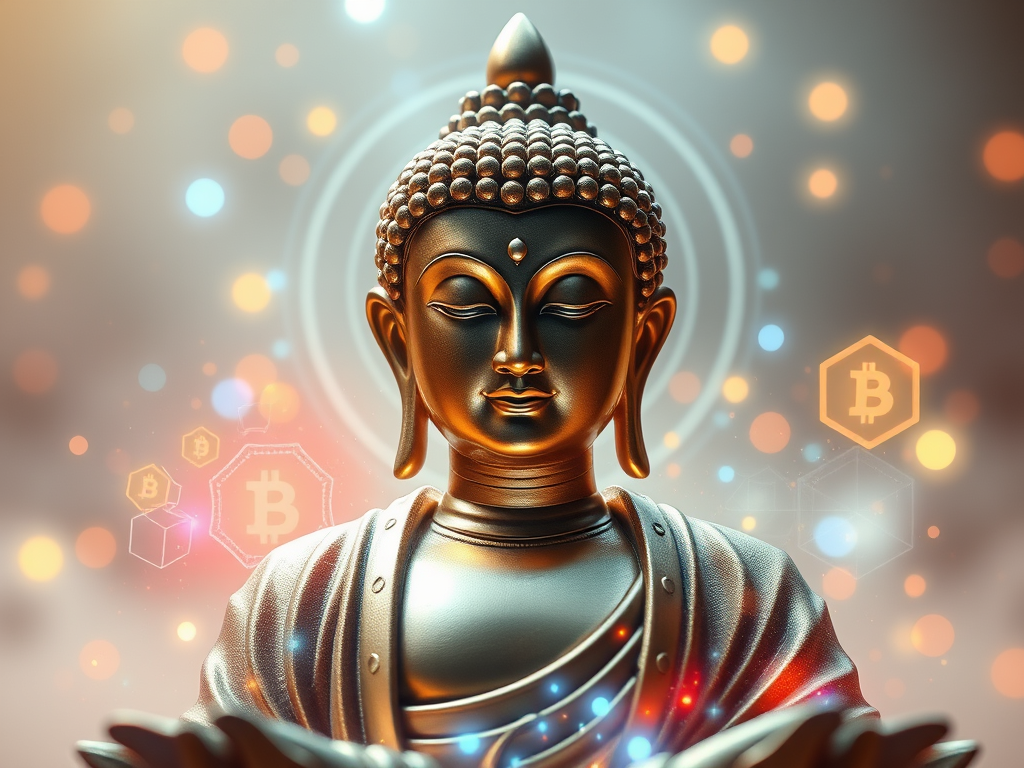
  • Exploring Buddhist NFTs: A Fusion of Tradition and Technology

    Exploring Buddhist NFTs: A Fusion of Tradition and Technology

    Cryptocurrency and Buddhism are two of my favourite topics currently so you can imagine how my interest was piqued when I came across a news article stating the two had paired in the virtual world.

    The cryptocurrency world is still very much a niche one and if your only experience coming across the terms crypto, Bitcoin and NFTs is through traditional media then let me quickly explain what it’s all about.

    First we need to start with the term blockchain. Blockchain is a relatively new digital technology designed to act as a ledger recording the movement of money to and from accounts registered on that ledger. In effect it replaces the ledger of a bank bringing it out into the open allowing anyone to read it, should they wish to do so, thereby technically (literally) removing the capacity of dodgy actors from amending the ledger for their own nefarious intentions. In a nutshell, it’s a ledger that removes human naughtiness. There are various types of blockchain out there with differing capabilities and capacities but all built upon that core concept.

    NFTs (non-fungible tokens; ie, non-identical tokens) are an asset that have been built onto the blockchain to prove ownership of that asset. So for example, should a person wish to sell their house they could cut out the middle-man and create a contract/title deed on the blockchain ledger. This entry onto the blockchain as already stated, cannot be tampered with and would show very clearly the person whom originally owned it, how much they were paid to sell the house and who has become the new owner, for this reason there is no way the new ownership can be disputed. This new technology certainly has pitfalls but the intention is to avoid scams and fraud and provide a tidy trail of transactions and proof of ownership that everyone can see. In fact, the likes of Rolex are currently onboarding this technology so that on purchase of your brand new Rolex you can check on the blockchain that it is legitimate and not a fake. There even has been talk of trying to quantify Earth’s resources (animals and fish included) and put them on the blockchain in an attempt to provide more sustainable usage of resources and conservation.

    Such radical changes can elicit strong reactions from our egos as we look to categorise if the change is beneficial or catastrophic but the truth is we cannot possibly know the future of the path, we can only know the present moment. So, good? Bad? Who knows? Here is a great, old Chinese story of unknown origin to illustrate this.

    A farmer used a horse to farm his fields. One day, the horse ran away into the hills. The farmer’s neighbours sympathised with the old man over his bad luck, with the farmer replying, “Bad luck? Good luck? Who knows?”

    A week later, the horse returned with a herd of wild horses from the hills, and this time the neighbours congratulated the farmer on his good luck. He replied, “Good luck? Bad luck? Who knows?”

    Then, when the farmer’s son was attempting to tame one of the wild horses he fell off and broke his leg. Everyone again sympathized with the farmer over his bad luck. But the farmer’s reaction was, “Bad luck? Good luck? Who knows?”

    War broke out in the country and some weeks later, the army marched into the village to draft every able-bodied youth they could find. When they saw the farmer’s son with his broken leg, they let him stay.

    Good luck? Bad luck? Who knows?

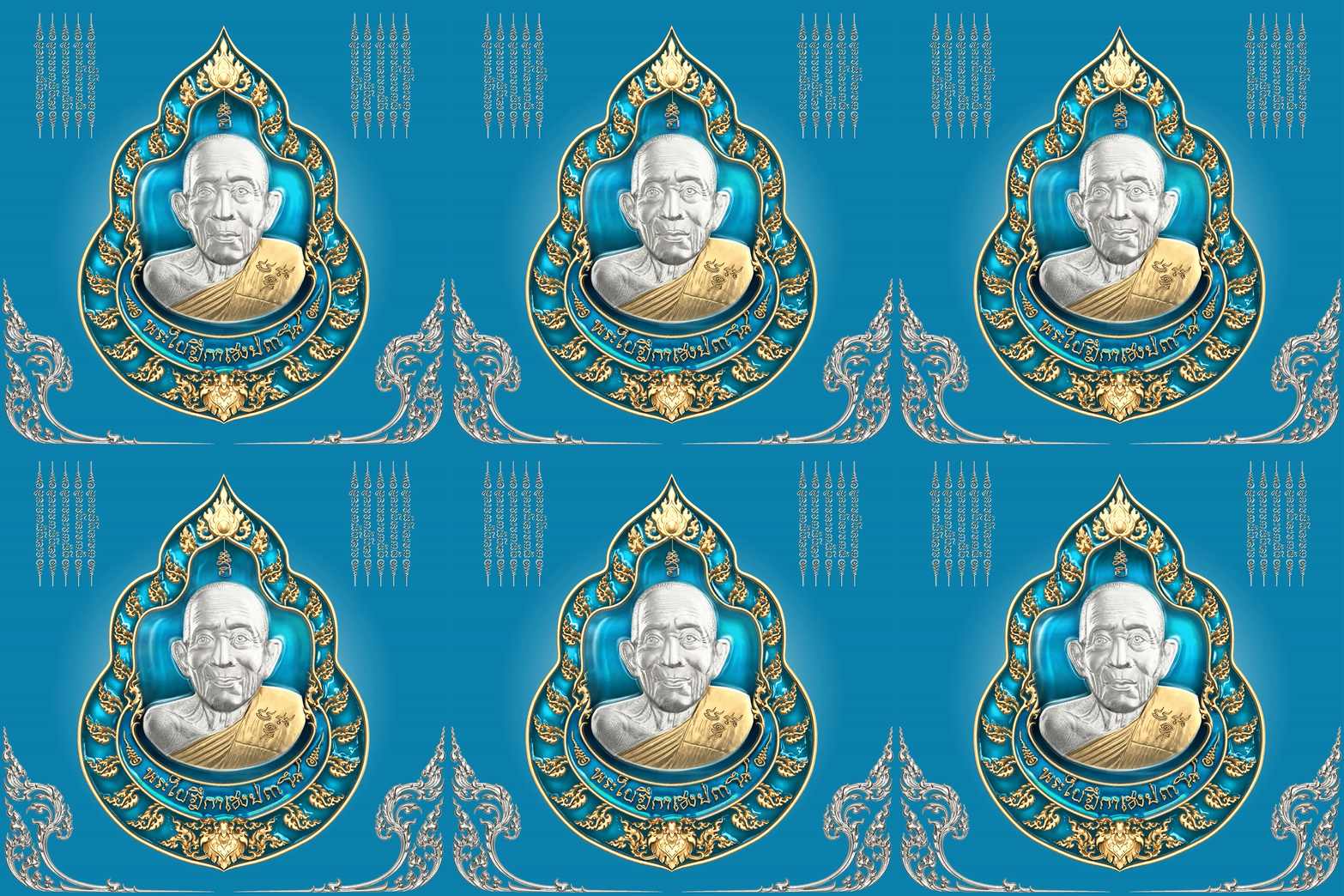
    PHOTO: Premium CryptoAmulets NFTs move as the monk smiles. (via CryptoAmulets.io)

    Hopefully you’re still with me as I lead you onto how NFTs have met with Buddhism

    It was reported, only a couple of months ago, that a new type of digital, Buddhist amulet would be making its mark on the NFT space of the crypto world; the first of its kind.

    After being approached by a Thai entrepreneurial business, Luang Pu Heng, a 95-year old monk from Thailand’s Surin Province agreed to create and bless digital, NFT amulets for the company, adding some of his own written blessings and chants before they were uploaded onto the Ethereum blockchain and put up to auction online. There are only 8000 of these amulets available to buy, ranging from a price of 0.02 – 0.8 Ethereum (at the time of writing this is equivalent to $46 – $1870) with varying characteristics and of differing rarities, just like you would see in physical amulets. There won’t have been any exchange of money in the creation of these amulets as Buddhist monastics do not handle money but it can be seen from the website, CryptoAmulets.io that 18% of proceeds will be donated to temples in Surin, ventilators for the hospitals and assistance to those in need.

    Thai Buddhist amulets are a type of blessed item made from a range of differing materials, that can offer protection, luck and other types of blessings and chants to enhance your life. The amulets can act as a source of income for a monastery to look after the monks and bhikkunis and ensure the survival of the monastery, yet more importantly than that, it’s a way of transferring the pure, loving energy of the Buddhist monastics to the lay people. In addition to this, the Thai wording written on the amulet has been done so by Luang Pu Heng himself who has clearly, very openly taken this new technology in his stride, setting an example that change is nothing to be feared and something only to be adapted to. There is another angle to this too that is of interest to me and that is the difference of having a physical amulet compared to a digital one. The chanting and blessings made by the monastics transfer a physical resonance to the amulet which you in turn are then exposed to by carrying it with you or placing on the dashboard of your car, for example. This resonance will be of a higher frequency due to the purity of the being who has conducted the blessing thereby bestowing good fortune to the holder. So the thought of having the resonance of the digital amulet very much “living” in your smartphone, and with most of your daily life existing as processes on your smartphone, I can’t think of a better thing to exist in it than the energy of a Buddhist monk. Perhaps it can create more lucky opportunities for those applying for jobs on their phone, whilst warding off scam callers!

    Our world is changing rapidly at the moment, from the climate to society, to technology. Some of these changes are frightening, taking us away from the knowledge we have from our most recent ancestors and early-life education and can lead us to thought processes of “it shouldn’t be like this” or, “if we were to do [x], then we could return to [y]” and no doubt leaves you in a state of uneasiness and fear. What I have found to be true, and in keeping with the Daoist philosophy of abiding in nature and the Buddhist philosophy of staying with the present moment, is that there is no space for the ‘shoulda-coulda-wouldas’ only a peaceful existence of what is. This approach has helped me more readily accept the changes to our digital technology evolution, having shied away myself from smartphones and social media.

    There is much I haven’t commented on in regards to the actual attainment of these NFT amulets and how they are still only really available to those of you who know how to navigate the cryptocurrency space. However, if you were interested in purchasing one yourself and need assistance with the steps please reach out and I’ll be happy to help. (Disclaimer: This is *not* a sponsored post, I have no affiliation with the company, I am not a financial advisor and I don’t own an amulet myself more so due to a lack of funds! Make sure you do your own research before making any purchases, as with anything!)

    For me though, I personally love the smiling monk looking back at me from the screen and I find a smile crossing my face too and this experience is evidence enough to me that there is something beautiful in this creation.

    If you enjoyed this blog then please click the “Like” button, share it with your friends and drop a comment below whether you would purchase a digital amulet versus a physical one. Thank you as always for taking the time to read my blog, I appreciate each and every one of you.

  • Overcoming the Inner Critic: Finding Peace with ‘No-Mind’

    Do you feel as though you should always be doing more, or something different? That you should be better? That you can’t quite find the formula to make your life a success?

    This has been me for the majority of my life and I’m certain you are no stranger to it either, the inner critic. The monkey mind. The ego. An all so common human condition that leads to a circular and continuous state of suffering. This isn’t exactly reassuring to know if you believe this is the only way to exist, bouncing from one state of doubt and worry to another but what if I told you that this mind-state could be considered abnormal, that it isn’t the state of mind that the mind really wants to abide in. My journey over the last year and a half has introduced an entirely new concept to me, the concept of “no-mind” where doubts and worries are softly let go and a peace and calm descends over your very being allowing you to move through life with fluidity and ease.

    After I left university (an experience that baffled me from start to finish), I had concepts of what would happen next. With a little bit of effort, but not too much, I would find a decent paying job, certainly above minimum wage, I would live somewhere I liked (quiet area with a small garden and dry walls) and have enough money left over each month to be able to afford a car and replace my ageing clothes every now and then. My aspirations weren’t wild.

    What I found to happen instead, was a far cry from my expectations.

    I ended up travelling around the world for a couple of years as I couldn’t find a job in my field of study and I found living in the UK to be as baffling as the university degree that I took in it. Whilst travelling around the world is rarely viewed as a negative experience, a lot of this time was spent in fear and obsessive thought, thinking what on this blue-and-green Earth was I doing and shouldn’t I really be getting a “proper” job? A lot of the beauty of the moment was lost on me and many of my choices were based on “shoulds and shouldn’ts”. This mind-state eventually brought me back to the UK, where struggling to know what job to now pursue I ended up retraining in the fitness industry, scraping by on a minimum wage, working two jobs and being bled dry by the costs of rent and a car. This was a challenging time as I relied upon the support of family, friends and family friends to get by. There wasn’t any feeling of being a successful, independent adult when I was so heavily reliant on others propping me up and left me in almost constant state of confusion and anger.

    During this period I tried to control all parts of my life through mental proliferation, where mental proliferation is the process of getting carried away with your thoughts, leading to the creation of more thoughts, more worries, more doubts and a world of suffering. Mental proliferation of the mind focuses on what has happened in the past and what may happen in the future, yet, the one place it cannot exist in is the present moment; the silver bullet to needless suffering. Now, at the time of university, subsequent global travelling and job working in the UK, I had no concept of my mind being the problem; it was my problem solver that got me out of trouble and into jobs. Right?

    The world is infinitely complex and beyond our capacity to measure and map-out, it is thus impossible to control. The Daosists have a name for this web of inter-relationships, they call it the Dao. My explanation in itself misses the point as the Dao is, indescribable. A great ancient sage by the name of Lao Tzu famously wrote the Dao De Ching that beautifully puts into words the relationship we have with the Dao, being of the Dao itself, and acts as a framework for how we approach our lives and environment. In particular I was struck by Wu-Wei, a practice of “non-doing” of taking a step back and being more aware in the present moment, of not actively pursuing decision-making.

    These concepts are beautiful to read and listen to and feel reassuring, whilst having a depth of ancient wisdom that touches you profoundly. What I found though with having discovered this information was that it still remained very much a mental proliferation, and did little to stop me analysing my life choices. If I was to follow in this practice of Wu-Wei (non-doing) then what was I supposed to be doing?! Perhaps you can see my dilemma.

    I was stuck in theoretical Daoism.

    That was, until I was introduced to the Buddha’s reflections on the workings of the mind. Now, until recently I hadn’t any interest in Buddhism, I considered it be the “philosophical religion” and didn’t see how it had any particular value or relevance in my life when I was so focused on my work and making ends meet. I had certainly read many a misplaced and out-of-context quote of the Buddha which may have superficially resonated with me but didn’t light a spark to follow it any further. What I have since come to understand is that the teachings of the Buddha are the most well understood teachings of the workings of the mind, that on discovery of these teachings I have been baffled as to why modern psychology exists at all.

    The Buddha illustrates through stories and lists why the mind behaves the way it does (such as the mental proliferation of desire; making choices because you desire something and you want it and making choices because you desire to get away from something you dislike) and what the different results are based on how you approach a situation. However this approach is not analytical such as the way in Western Psychology, instead I see it more as a reprogramming, a reconditioning based on the Four Noble Truths and the Eight Precepts and so on that sets you on the path towards enlightenment and the end of suffering. These teachings help develop wisdom and the ability to reflect on the workings of your mind whereby you are no longer plagued by doubts, desires, hatred and more.

    There is a trap here too however, just as in theoretical Daoism you can become stuck in theoretical Buddhism, which is why I was also taught the practical mind skills too, otherwise known as meditation. I’m not so sure that meditation compliments the Buddha’s understanding of the mind as much as it is the practice of the Buddha’s understanding of the mind. To forgo meditation in the belief that simply reading the written word will help you does not lead to the life-changing insight that is possible. Meditation is immeasurable despite what some technology groups may be trying to achieve today. I have heard people talk about entering into Jhana states and Buddhist monks who can meditate for hours or days at a time, yet meditation cannot be measured in terms of success by the experiences you have as much as how much you have let go in day-to-day life. My meditation practice has been far more basic, I typically sit for 30 minutes with nothing otherworldly happen, yet I do find myself enter into a more peaceful state where mental proliferation dies down and those immediate, loud thoughts slowly soften and dissolve.

    This regular practice has been enough to slowly drop the notions of being a somebody that strives to make something of themselves in the world and to quieten the inner dialogue. This is turn drops the ideas of “I should be doing this or that”, “I should be here or there”, “will people still like me if I do this or that”, “I need to go out and save the world, but how?!” and has brought me closer to a state of Wu-Wei that I had previously tried to access through the thinking mind.

    In time, this has led me to pursue awareness in the present moment above all else. Awareness itself does not hold as much theoretical or literary prowess, it’s not as exhilarating to read or hear about, yet, it has been the most powerful transformational tool I have encountered to date and can be harnessed and refined further through meditation.

    I have found that when I am in this present moment, my mental proliferation subsides or simply doesn’t exist. I note that the present feels like “this” and this liberates me from the notion that there is any path to follow other than my own.

    And that’s all there seems to me to be.

  • Poem : Oneness

    There’s so much more to life you see,


    I am you and you are me,


    The sand and stars, the sea and moon,


    Can fit inside this tiny room;


    If you but open your third eye,


    My dear, you will surely fly.

    -EC

  • The Perfection of Giving in Buddhism

    In Buddhism we can find advice on how to live a noble life as we embark on a path towards enlightenment. Regardless of your belief system these teachings can assist in bringing clarity towards your intentions and actions in life and can aid in shifting delusion, ill will and greed by stepping away from egocentric practices. Through this focus one can generate greater compassion and an appreciation for life “as it comes” rather than as “it should be”.

    The Buddha talked about Dana (The Perfection of Giving) in relation to the teaching of ‘The Six Paramitas’ or ‘The Six Perfections of Character’ (there are 10 listed in Theravadan Buddhism). The Six Paramitas are the perfection of giving, morality (proper conduct), patience (or tolerance), effort, meditation and wisdom (or discernment) and are to be cultivated if we wish to move away from suffering towards peacefulness and happiness.

    Dana : The Generosity of Giving

    The Perfection of Giving is considered to be one of the first Paramitas to be developed as it develops the skill of metta (loving-kindness). As we develop greater metta we awaken our hearts furthering unconditional giving and selflessness. It is important to highlight that being the giver and being the receiver are of equal importance in this interaction. The Western awkwardness of “politely” rejecting gifts whether they be material, time, money or work, does not allow for a harmonised experience of giving and receiving. This conditioning of politeness can show us how far our conditioning can throw us from peaceful living. By denying a person the opportunity to give, we deny them the joy of giving and developing their metta further.

    Giving and receiving arise as one, you cannot give without having a receiver and you cannot receive without having a giver so both sides must be respected in equal measure.

    A personal experience of caring and rearing two wild-born black rats from the age of 1-week old to 6-weeks provided me with my first taste of selfless giving. In their pure innocence and vulnerability of needing to be cared for in order to survive, they gave me my first real taste of selflessness and the pureness and joy of giving.

    To be accomplished in The Generosity of Giving can be expected like so:

    “What is accomplishment in generosity? Here, a noble disciple dwells at home with a mind free from the stain of miserliness, freely generous, open-handed, delighting in relinquishment, devoted to charity, delighting in giving and sharing. This is called accomplishment in generosity.” 

    AN 4:61, NDB 450

    The Eight Reasons For Giving

    The Buddha mentions eight reasons that we may give a gift and these eight reasons can be interpreted as moving from lower levels of awareness filled with greed, delusion and hatred towards higher levels of awareness that bring us closer to our enlightened selves. These are as follows:

    1. One gives a gift from desire.

    2. One gives a gift from hatred.

    3. One gives a gift from delusion.

    4. One gives a gift from fear.

    5. One gives a gift based in mental conditioning and obligation, thinking, ‘Giving was practiced before by my father and forefathers; I should not abandon this ancient family custom’.

    6. One gives a gift in consideration of good kamma in the next life, thinking: ‘Having given this gift, with the breakup of the body, after death, I will be reborn in a good destination, in a heavenly world

    7. One gives a gift for the purpose of joy, thinking: ‘When I am giving this gift my mind becomes placid, and elation and joy arise.’

    8. One gives a gift for the purpose of ornamenting or beautifying the mind and increasing the skill of metta.

    As you move down the list of reasons for giving, the giver becomes less and less identified with themselves as an individual needing to accomplish something in life and more in tune with the wholesomeness of the practice where the giver and receiver are one. As we develop this practice we move away from expecting outcomes from our gift giving realising that the act of giving is to let go of the ego rather than to fuel it further.

    The next time you find yourself involved in the act of giving, give yourself the opportunity to reflect before, during and after on the above points. Perhaps you can identify the intention behind your gift giving based on one or more of the points. Where possible avoid rational thinking and reasoning from taking charge and instead be aware that this action is resulting in mental proliferation (trying to “figure it all out”). Be aware that the act of giving felt like this and trust in the present moment awareness where no action is needed to be taken and the awareness itself is all that’s needed.

    If you found this to be helpful or of interest please like, subscribe and share and drop a comment down below and thank you for taking the time to read!

  • Understanding Death: A Journey Through Eastern and Western Views

    Understanding Death: A Journey Through Eastern and Western Views

    Around 3 weeks ago I found two, wild, rat kittens lying on a path whilst birds swooped down and pecked at them, not to eat but to eliminate a perceived threat.  It was apparent that the modeling of these particular bird brains did not allow them to discern the different levels of threat between a baby and adult rat, only that all rats are a threat.  At first I couldn’t make out what lay on the path, I walked over to find a little body laying there with eyes still firmly closed and a cut to the side of it’s abdomen in the shape of a bird peak.  I instinctively picked him up. A little way to the side lay his brother with a bigger cut to his head.  I carried them around in my hands for a while, attempting to keep them warm whilst trying to decipher where they’d come from and was there any possibility of returning them to their nest.  With the threat of birds overhead it wasn’t feasible to leave them on the path for their mother to retrieve them.  Unfortunately no nest could be located so I took them in and spent the next two weeks nursing them first with baby formula and then gradually weaning them onto solid foods.  Gradually their eyes and ears opened and they began exploring their purpose-built cage to house them until they were old enough to be released back into the wild.  What I found most surprising was the distance and speed they moved at when still totally blind, as though they were simply too impatient to wait for their eyes to open and would get on with exploring anyhow.  Perhaps they were precocious learners.

    At the 3 week mark, it seemed like we had made it. They were fully weaned, growing in size, and were far more balanced with their movements. And yet, Pip’s breathing had changed.  Each time he breathed in he produced a clicking sound and his breathing rate was ever so fast.  He had pulled himself out of his nest box one morning and was laying in what I would have considered too exposed an area for a rat and everything about his behaviour was muted and diminished.  By the late afternoon he had passed away.

    I had the rare opportunity of holding him in my hands during the final couple of hours. I witnessed the transition from life into death. This experience raised several questions in myself both during and after the event.  Would it be right to interfere with the process and take him to a vet to “save” his life?  What is the relevance of his body once he’s died and where is “he” now?

    Should I have attempted to “save” Pip with medical intervention?

    The answer to this question depends very much on which culture you have been raised in. It also depends on what your belief system is.  For simplicity’s sake, I will define the West as containing the Christian, Muslim, and Judaism faiths. The East includes Buddhism, Taoism, Hinduism, Jainism, etc.

    The Western faiths believe that there is only one life. Once you die, you head either to heaven or hell. This belief gives you two options of living. You can make the most of it, as time is running out. Alternatively, you can rely on Heaven as the ultimate goal. It is viewed as an everlasting life. This makes what happens on Earth seem irrelevant.  The East believes something very different. They believe you have infinite lives. You are constantly reborn once one life has ended. This cycle continues to increase your level of consciousness until you reach enlightenment and return to the Source.  In the West, religion has been steadily declining. What’s interesting is that even if you’re an atheist with a strong disdain for religion, you have been socially conditioned. You still believe there is only one life. This is because religion is so deeply embedded in our societies.  This permeates deeply through all levels of our behaviour, so imagine how differently you might behave if you not only believed but knew that your life force/energy/soul was brought back into a living body after each death.  Perhaps life wouldn’t be such a rush to reach the top, feeling like time was always running out; perhaps you wouldn’t be filled with anxiety of having to achieve things earlier in life in order to have time and money to enjoy and experience things as you age.  What about your job? What about your body? Think about your responsibilities. How do these all change when you consider that perhaps there isn’t one life only for each of us? #YOLO (You Only Live Once) sounds like a pretty ridiculous handle but an unfortunate representation of how people can and do behave with that belief system.  For those unfamiliar with #YOLO, it is an abbreviation used for behaving recklessly under the assumption that you only live once so should make the most out of life, whether it’s binge drinking and drug sessions, unprotected sex, dangerous stunts, you get the drift.

    Osho very succinctly puts into words our Western social conditioning on death.

    “We have been taught for centuries that death is against life, that death is the enemy of life, that death is the end of life.  Of course, we are scared and cannot relax, cannot be in a let-go.  And if you cannot be in a let-go with death, you will remain tense in your life, because death is not separate from life.”

    To speak of death in the West in terms other than how to increase longevity and achieve immortality is seen as taboo, perverse, religious or spiritual nonsense or farcical, such is the fear and lack of understanding of it.  My experience with Pip and my own personal exploration into Eastern philosophy and the Buddhist understanding of the mind has led me to question the truth of a “one life only” paradigm.  At this stage I am still full of questions and so the idea that your life force is reseeded in another body is still something to be further explored, to find my own understanding and experience this for myself by way of meditation, yet I have a strong sense of knowing that I’m on the right path.

    My exploration into all of this led me onto something really interesting on how we have been socially conditioned to believe in either one life or many.

    Jesus, Mohammed, Buddha, Krishna, etc.  were all great teachers of their times and the manner in which they shared their teachings was dependent upon the social behaviours of their societies in their eras and regions.  It’s worth noting that religions did not attach themselves to their teachings until after their deaths, in the case of Buddha, some 500 years after his death and one should therefore be careful not to confuse religious dogma and agenda with the pure teachings of these men.  In the case of the Eastern teachers they had known for thousands of years that reincarnation was true, it wasn’t only a theory that was taught but had anecdotal evidence to support it.  Jesus and Moses were known to have traveled to India and would have therefore come across these teachings and evidence and yet upon their return to the West they didn’t share this with their disciples.  The reason was that they had noted how the theory of reincarnation had made the Indians very lethargic in life; when you know you will have multiple lives, what is the rush in doing anything.  This wasn’t the case though when Buddha and Krishna originally shared their teachings hundreds of years previously, in fact, India was a rich country then with very bored people, so they painted a picture of having to live with the same boredom life after life, whipping people into shape and encouraging them to pursue meditation and enlightenment.  But then India entered into a period of poverty, still grasping on the theory of reincarnation, they now found themselves hoping for an escape in their next life.  This life hasn’t worked out, maybe the next one will.   This escapism resulted in avoidance of living to the fullest and the postponement of living.  Jesus and Moses saw this and realised the strategy was no longer working, so on their return to the West they shared a different story, one where you only have one life so if you want to enlighten, if you want to meditate, do it now, don’t put it off till tomorrow, time is ticking.  And it is through this mechanism that the West has now become pathological with it’s concept of time and linear living.  Just like with Buddha and Krishna, Jesus, Mohammed and Moses’ teachings worked for the era that they lived but there comes a time when the framework of society shifts and holding onto old teachings can be detrimental.  It is for this reason that you shouldn’t accept any belief you hold without having first questioned it fully.

    To take this back to the question then of whether medical intervention was necessary depends, partly, on how strongly you believe in one life vs many.  In the West it seems now more than ever that we cannot accept that people die, everyone must be saved and strong, violence-based terms are used to combat, attack, fight, destroy illnesses or diseases as though death is the enemy rather than a natural process.  It is as though people have forgotten that we are nature and nature can end this life at any time.  As such, people are not dying naturally at home like they might have done only some 150 years ago but instead make frequent hospital trips for intensive and extensive treatment up to the day they die.  Personally this sounds incredibly stressful and a fight to avoid death means  fear will hold strong in those final moments, dying at home or in nature is the way I want to go.

    I recall a news report a few years back in Australia of a young man who died as a result of a shark attack when he was out surfing.  As he was sat on his board with his legs dangling over the sides, a sizeable shark bit his legs.  His friends around him went to grab him and pull him ashore and uncharacteristically the shark didn’t let go as they normally would when making an error in food source.  There was a tug of war and eventually the shark swam off, leaving the friends to pull the young man ashore.  On the beach it was evident he’d lost at least one of his legs and was bleeding profusely. All of this sounds horrific, like a scene of out Jaws (a film that plays our your fear of dying violently) and yet his friends recounted that he was totally calm and asked that they pass along his love to his loved ones before dying.  It was highly likely that his body had responded to the shock of the attack preventing him from feeling pain and allowing him to peacefully move on which in one sense was perfect.  It was those that had witnessed the event that most likely suffered the worst of it and without the wisdom of an elder it will only reinforce that death is something to be feared.

    I should probably make it clear that I do believe in medical intervention, however there is a fine line between knowing when to let go and when you are simply avoiding dying out of fear of death and I think the ease of finding this line can only be put down to how enlightened both the person dying is as well as the person caring for them.  Having said this if you live a life close to nature following it’s natural rhythms with a healthy attitude towards death, there shouldn’t be too much opportunity for medical intervention as you lead a life of preventative care.

    Does your body make you you?

    Imagine for a moment that the essence, the life force, the soul, whichever term you feel is relevant, of your loved one was moved out of their body and into another and into their body was placed another life force.  Which body would you feel that same connection to, would it be the body that looks like them, or the body that contains their energy, their personality, behavioural patterns etc?

    In the process of Pip passing away in my hands, his breathing became slower and slower until finally he breathed in but didn’t breathe out again.  Almost instantly he became unrecognisable, something drastically had changed and yet all the identifiable features of his body remained.  The scar of the bird beak on his head was still there.  Yet after that moment of dying his body was that of any rat which lead me to truly knowing that his body wasn’t HIM, it was merely a meat suit or a shell that housed his true essence.  What that true essence is though I know only to describe as his energy force which vibrated at a specific frequency, a fingerprint unique to him.

    On a basic level your body is little more than an assimilation of memory based around the framework of a genetic blueprint heralding back from all your ancestors and evolutionary history (more than a few terabytes of data there.) As you operate your body through life it picks up more memory through the environments you expose it to, the substances it consumes, the knowledge it acquires and then should you have offspring, this memory is passed on through genetics.  I am not suggesting that you should disregard your body as little more than a vessel, in fact, I am of the view that the body should be well looked after with and understanding of how to maintain homeostatic internal process through allostasis and that through doing this you can use your body to further your process of enlightenment, however it is not to believe that your body IS you.

    So if your body doesn’t make you you, then what does and if you’ve spent your life defining yourself by your appearance how will this affect you?

    This requires an even deeper dive into a fundamental understanding of the mind and the Eastern philosophies that I shall perhaps cover in another blog if anyone is interested.  However if I mention something in short, it would be that the ultimate goal is to achieve enlightenment, in doing so you free yourself from the Earthly realm.  To go about achieving enlightenment is to basically work through your issues.  Every single thing you think you know about yourself needs to be overturned and examined and by doing this you slowly rid yourself of your conditioned beliefs, your angry outbursts, your patterns of cheating on your partner, your need to consume alcohol to get through life etc.  Every time you rid yourself of one of these patterns you’ve taken a step closer to enlightenment.  My understanding is that during each lifetime, you work through as much as you can and when you’re reborn in your next life you start from where you left off.  Therefore if you spend a lifetime believing you are your body you have in one sense wasted a life and will be born at the same level of consciousness that you died, finding yourself in an endless loop of suffering.

    And so I find that little Pip who only graced my life for two short weeks has helped me shape my views on dying and living, perhaps I’ll meet him again.

    This blog is not force you to believe anything different to what you already know and understand but to have you question those beliefs and to question how you’ve come to believe what you believe –  has it been through personal enquiry or because “that’s what I’ve always known”, and therefore, social conditioning?

    “It’s an absolute certain fact that people die, animals die, trees die, birds die.  How can you avoid the fact that you are also going to die – maybe tomorrow, maybe the day after tomorrow?  It is only a question of time.  But still, those who are aware of their being know that nobody dies.  Death is an illusion”.  Osho, Death: The Greatest Fiction.

    Thank you for taking the time to read my blog.  If you found it interesting, please like and subscribe and drop a comment below too as it helps the algorithm immensely.


  • Nature is but a Mirror

    How does each of us relate to our environment?  More often, through formal channels such as the news, or simply with our friends we speak of how we relate to society; talking of the interdependent relationship we have with the environment is more a special moment chat when the stars have aligned, Saturn is waxing, the Moon has risen in Mercury and a black hole has swallowed Elon Musk’s Starlink.

    From my own experience and observation, how much more important it seems to each of us to deal with the immediate aspects of our life, work, romance, food shops, keeping ourselves entertained.  We critique the government, our bosses and authority and declare that we “can do a better job!”.  Gossiping on the comings and goings of the lives of our co-workers and friends take up endless hours of time.  We realise at some level that we are a small cog in our society and we fulfill our cogly-role of selecting a job enabled by the government, consuming everything we want and need, and giving voice from the sidelines on how our lives could be lived better if x, y and z changed, with never walking onto the field to participate in the game of life.  But how often do we really consider that we are also an even smaller cog in an even bigger “machine” of the Mother Earth and that every one of our actions influences our environment?  How insignificant our lives then appear to be, in fact, so insignificant that we go back to burying ourselves in alcohol, drugs and dopamine-inducing entertainment.

    Until recently, I did not spend all that much time contemplating such things. I didn’t have my head totally buried in the sand; I sorted my recycling, I made sure to never burn plastics or harmful materials on garden bonfires, I enjoyed being out in nature and I didn’t fulfill my role of being a consumer all that well.  Yet there was a marked disconnect within myself that I could feel, but not quite explain.

    I have found that you can watch the entire collection of David Attenborough’s, you can study Zoology at university, read countless books on natural history or even go to a zoo and you will still not understand nature to the same depth than if you were to sit outside and simply watch.  In fact, I’ve found the less you know about an animal and it’s habits, the more connected your experience as you tune in at a deeper level to what it’s doing.  Once you’ve associated a behaviour you’ve watched from a documentary to an animal, you now assume you now know what it’s doing, now you stop paying attention.  This is not to say that there isn’t validity to nature documentaries but they are merely a band-aid to keeping us slightly connected to what’s going on in the natural world.  When I first got here I didn’t pay such close attention, birds flew past but they all flew the same.  Not until I started paying attention did I notice, with enthusiasm, that the crane extends it’s legs some time before landing much like a plane deploying it’s landing gear on a run up to the runway, sometimes dipping it’s toes into the water; or drongos that seemingly perform Red Arrows style flying maneuvers with barrel rolls and loop-the-loops whenever they take flight (I sometimes think they would get where they’re going a hell of a lot faster if they just cut that out all together); or house martins flying against stormy winds tack across the sky like boats battling waves.

    A few weeks ago I discovered with my mum, two mist nets at the bottom of our garden, on the other side of our wall.  These are used to catch birds.  Made of fine netting strung up between two poles (thing of a volleyball net), the birds blind to it, fly straight in and become ensnared by the net. A menagerie of birds had already been caught and hung there, alive, yet immobile.  It was a horrifying and sickening sight, it reminded me of tiny corpses being strung up to ward off any other dissenters.  For a while we ourselves were immobile.  What should we do?  Every cell was screaming we should cut them free and release them, it was cruel and barbaric, this is no way to treat animals but the conditioning of society quietly crept in.  The net isn’t on our land, we are foreigners in this country and shouldn’t involve ourselves with the locals business, maybe this person is struggling to come by food in this lock-down, maybe they have a family to feed.

    After much too-ing and fro-ing we released the one bird we could, a young zebra dove (one of its parents and sibling were also caught in the net) that hung lower and closer to our wall than the rest.  Our hands shook as we worked to cut the netting away.  The entire time it remained totally calm and I could feel it’s heart beating slowly, far slower than mine that was racing, afraid the person would return and catch us in the act.  For a few precious moments I held the zebra dove in my hand until it seemingly felt ready to leave, broke through my light grasp and took off.  It was some hours later that a man showed up to remove the birds and we politely asked him to remove the net, which he graciously obliged.

    It was very distressing to see the birds caught in the net and yet the man could not be blamed for what he was doing, in fact he handled all the birds very softly as he removed them from the net and placed them in a sack.  He was doing what he could do best to survive with the tools and conditioning he had available to him.  These sorts of behaviours cannot be pinned on a certain type of person, a community or a nation, it lies in each and every one of us with our lifestyles, our spending habits, the fact that we have spending habits and our incessant desires that we have no awareness or control over.  When we can’t control how products are made and disposed of, how natural resources are  harvested, government policies and greater societal cogs, the one thing we can control is ourselves.  The more we can still our minds, ease our egos and desires, the more possibility there is for the likes of circular economies to exist, advanced communes, reduced pollution and sustainable co-existence with the environment.  The only reason we’re not there yet is because we’re not ready to be there.

    I for one think product design should include how the item will be dealt with once its finished with; do existing recycling methods allow for it to be recycled or do new methods need to be created.  If a new recycling method needs to be created then a company should pay into a “pot” to create the new technology to deal with this.  I feel the nuclear energy industry sums this up nicely – let’s create an energy that requires minimal resource and creates “only” steam as a by-product (sounds like the perfect source of energy), however in terms of dealing with radiated waste, let’s stick it in containers for now and work out how to deal with it later (are you mad?), now apply that scenario to your smartphone, your tablet, your fashionable trainers, your fridge.  A zero waste economy (or as close as) would mean everything made serves a function of the highest order and can be reused, recycled or repurposed.  This self-realisation on how society and the economy could better operate starts with me and know I am only at the start of this journey.

    The poor who live hand-to-mouth have not the livelihood to protect the planet.
    Those who live in comfort chase desire for money, status and power and have not the self-control to save the planet.
    The rich, consumed by their greed have not the purity of soul to safe-guard the planet.
    Those who have stilled their mind and desires have the serenity to rescue Mother Earth.
    And yet, there are so few.

    If you want to save/fix the world, save/fix yourself.

    93788372_2584521178477241_1985624558454964224_n

    (Photo of the rescued juvenile zebra dove)