Tag: Nature

  • How to Save Wild Baby Rats: A Practical Guide

    How to Save Wild Baby Rats: A Practical Guide

    Saving an animal’s life shouldn’t have to be costly. This is my comprehensive, no frills account of wild rat rearing based off my own experience.

    If you have been following my blog you will know I recently adopted two baby wild rats. As you might imagine, there isn’t all that information online on how to rescue and rear wild rats (most focus on eradication), so I had to make do with a selection of articles and blogs and piece it all together. In addition to this, all blogs/articles assume you have access to a wide range of products and vets to help you along the way, which I was without. What I have chosen to do is share my experience on how to save a rat sans vet, sans fancy soy formula or fancy heating pad. This is a rat rearing help guide for living out in the sticks; from capture to release.

    1. Return them to their mother.

    So you’ve found some baby rats. If you have found rat babies in a nest, leave them there, their mother will be sure to return soon and will move them to a new nest if need be. Taking on rat babies should only be attempted if there is immediate danger, or you have clearly identified that the mother has died. In my case it appeared that they had been pulled out of their nest, I suspect by birds, and left exposed in an open area where they were being pecked at. I was unable to locate their nest and I couldn’t have left them where they were without there being a risk to their lives.

    Don’t interfere unless necessary.

    2. So you’ve decided to become a rat mother and you don’t have access to a vet.

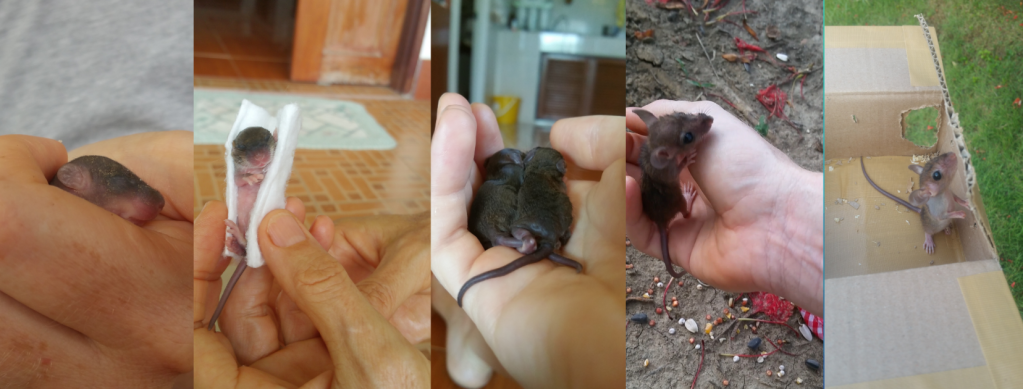
    At this stage most blogs suggest you take your kittens to a vet. I found Pip and Ratty at approximately 6 days old. Their eyes and ears were still closed and they had signs of fur breaking through. After my initial, unquestioning impulse of rescuing them it began to dawn on me that I may not have picked the “cleanest” of creatures to save. Rats are known to be prolific disease vectors, meaning that they carry bacteria or parasites in their blood or through third party travellers such as fleas. The rats themselves are not affected by these pathogens and appear healthy yet these can be transferred onto humans through close contact. This social conditioning was further compounded when I identified Pip and Ratty as Rattus rattus, the black rat, also known as the roof rat, as opposed to the brown, larger, sewer rat. Something about having a plague harboring creature in your home doesn’t feel like a grand idea.

    When talking in scientific terms its hard to remain emotionally attached. My experience with Pip and Ratty however couldn’t have been any further from that fact, and was a greatly rewarding experience where they taught me much about their own cleanliness, intelligence, playfulness and innate natures. Should you have found this blog because you too find yourself in a similar experience I’m certain you too will become bonded to your rat kittens.

    The only information I could find on baby rats carrying diseases suggested that at least until 1 week old they are simply too small to harbour anything nasty. This makes sense when you consider that parasites and bacteria require their host to survive in order for themselves to survive. A baby rat will not be able to provide the sustenance these pathogens require to survive without killing their host and therefore themselves. It is of course recommended to practice safe hygiene, wash your hands thoroughly and don’t have them up near your face.

    If there is any serious defect or injury to them, it is my own personal philosophy that it would be kinder to place them somewhere warm and quiet and allow them to move on. It so happened that at week 3 Pip picked up a suspected chest infection and within 24 hours passed away. You can read more about this in my previous blog “What Is Death?”. Pip and Ratty both came to me with cuts to their skin from bird pecks which I gave a gentle wash with warm water using a cotton bud – these healed quickly.

    3. Keeping your kitten warm.

    Until they start to develop their fur at around 2 weeks old, your kitten will be unable to keep itself warm. If you, like me, don’t have access to a heating pad or a thermometer to monitor the temperature of their new box home, you can use a hot water bottle wrapped in cloth and a little common sense. Ensure its not too hot as not only would it be painful to rest on but it can also dehydrate them. I opted for a little warmer than lukewarm and regularly checked it and refreshed it once it had cooled. This is a 24 hour job until they’ve grown enough fur to self-regulate. I placed them in a small-medium sized cardboard box along with some cushion wadding and hair from a hair cut for them to cosy up in! Make sure that whatever material you place in their box that they can’t accidentally become entangled in; felt or fleece are a good option if you have it. Whichever option you use for keeping them warm, ensure there is enough room for them to move away from the heat source if they need to cool down. Another thing to note is that your cardboard box should have enough height and a lid, you’ll be surprised at how much a blind rat explores and the speed at which they do, and they will climb out if the opportunity presents itself. Do not be complacent!

    4. Keeping your kitten fed.

    The thing I struggled with most at the start was knowing whether or not they were dehydrated. If they’ve been separated from their mother for some time it’s likely they will be. If you scrunch up the skin around their neck and it remains in that position after more than a couple of seconds its likely they are dehydrated. Whilst this is likely to be true I did also think that perhaps they’re simply wrinkly with plenty of extra skin. When I wasn’t sure I tended to water down their feed a little more.

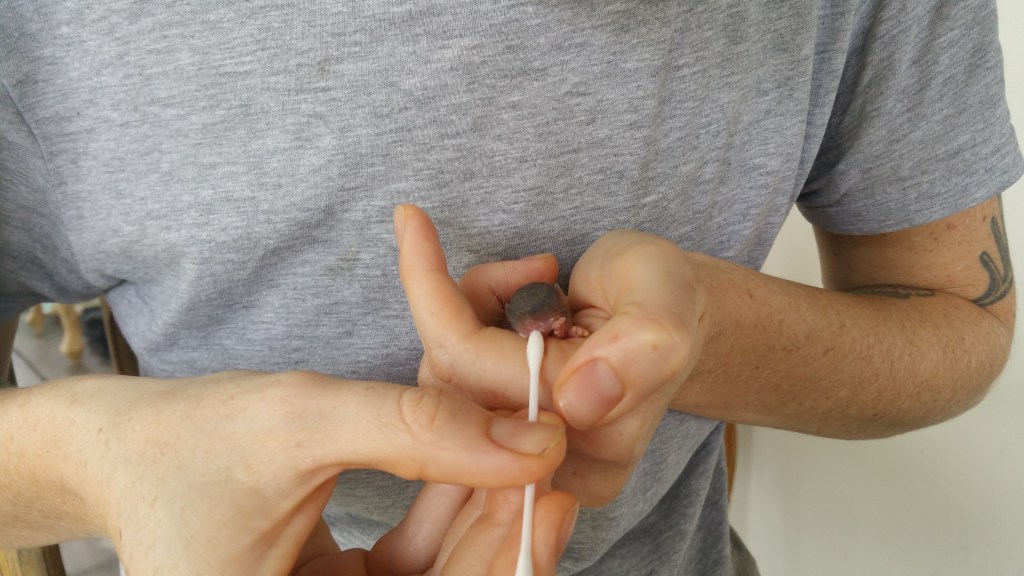
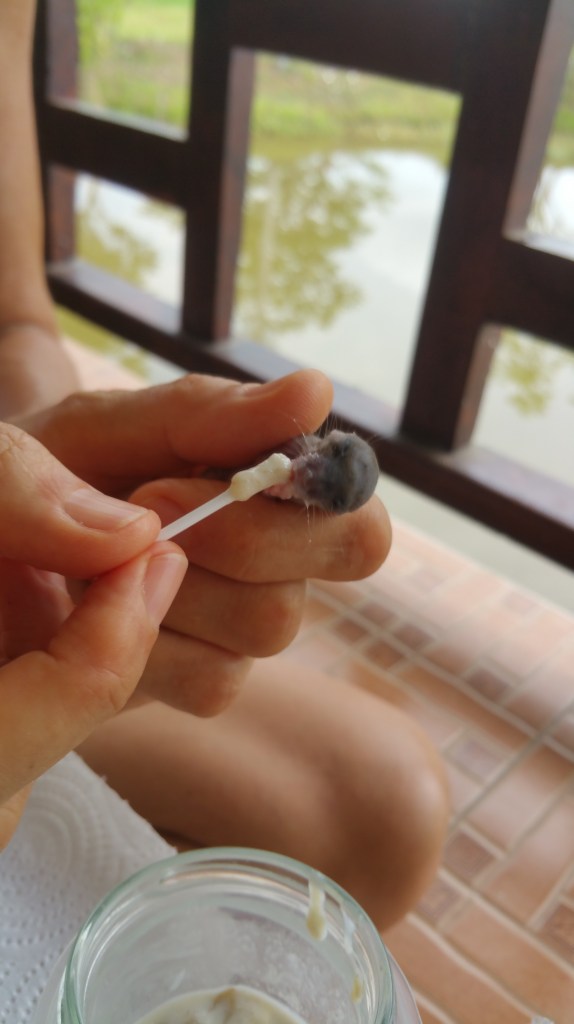
    For the first 12 hours I only had cows milk and evaporated milk on offer so offered this up via the means of a cotton wool bud as I had no pipette on hand. Like with most creatures, cows milk is not the best substitute for their mother’s as the compositon of milk is very different. The closest replication to rat milk is actually human baby formula, with soy being the better option. In my case it was the regular lactose based formula for ages 0-1 that was on offer and it worked perfectly fine.

    I found this blog to be helpful to know how much to feed my kittens as well as what their feed cycle should be. As I lacked a pipette initially I had no way of accurately calculating this so I relied on the kittens showing disinterest to determine when they’d had enough. Using a cotton bud was awfully slow and tedious and I did worry that it wasn’t working for them either as there’s only so much volume it can hold. So relatively early on (before reaching week 2), I added in a little mashed banana to the formula making it denser, which was a success. Over time I increased the mashed banana to formula ratio until they were weaned. I did eventually get a pipette which made feeding much quicker. The drawback to this method is being careful that you don’t force the food down too fast which can result in either forcing air into their stomachs causing a painful bloat, or forcing food into their lungs which will either cause suffocation or a chest infection. Whilst using a cotton bud it was certainly easier to avoid either of those things. You may notice that your kitten will open it’s mouth like a baby bird, this is a sign that it’s ready to power suck, a move that is possible when feeding with a pipette but not so much with a cotton bud.

    In terms of how to hold your kitten during feeds. You may find them to wriggle. You can hold them firmly upright by the scruff of the neck or you can encase them in your hand, keeping their legs tucked in. Patience is a virtue.

    Until week 2 they are unable to defecate by themselves and would have received stimulation from their mother to elicit a bowel movement. Before or after each feed you’ll need to stimulate their genitals, using a cotton bud dipped in warm water, to encourage them to poop out a small pellet and urinate. If its too runny they have diarrhea and you’ll need to make sure they don’t dehydrate. If they don’t urinate it’s likely they are dehydrated.

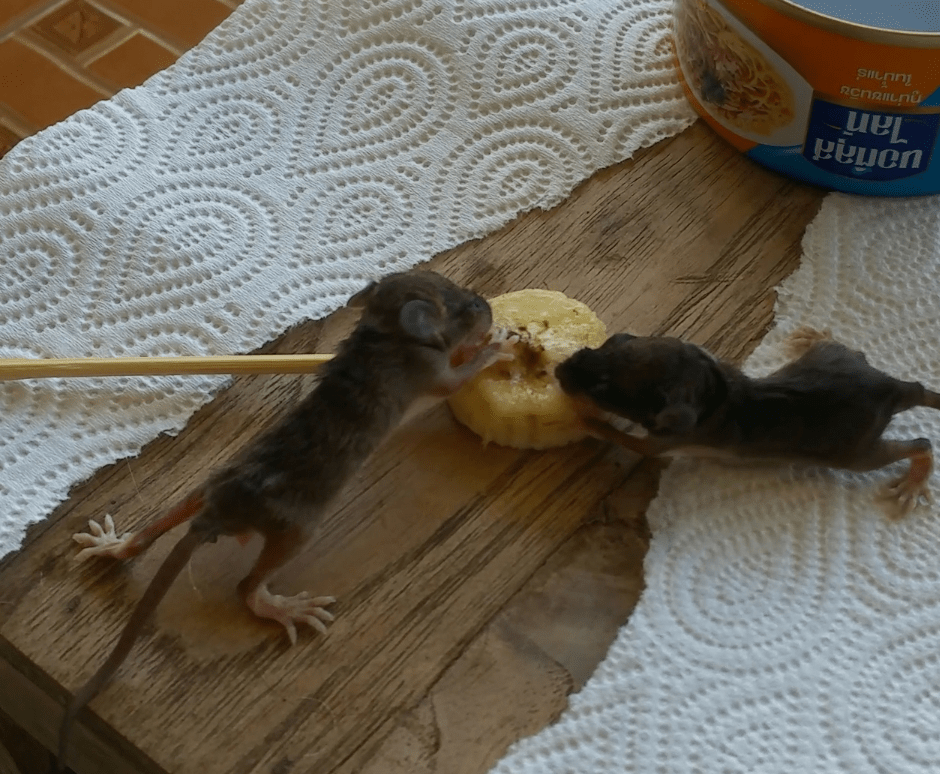
    Once their eyes had opened at approximately 2.5 weeks, I steadily introduced soft, whole foods such as bananas and cucumbers in a tin lid laid on the floor of their cage (until their eyes open you will need to keep feeding them by hand to avoid them accidentally inhaling food/liquids through their nose). It wasn’t long before their range of foods widened and they could handle seeds, nuts, hard veg and meat. I avoided giving them any cooked food as much as possible. I did get a hold of hamster biscuits (as rat biscuits weren’t available) which I gave in small portions, as well as dried alfalfa to keep their fibre intake high.

    The final note in terms of feeding is that once they were fully weaned I had to cycle through many different foods to keep it varied. After week 4, I searched for insects and beetles from the garden to feed Ratty.
    5. Deciding on releasing or keeping your kittens.

    It’s important to know from the start what you plan on doing with them once they’re weaned. Of the articles and blogs I could find most people suggested they kept the rats as pets, not many rewilded them. Depending on your goal will affect how you handle them. Up until approx week 3, you will be hands on with them as you hold them for feeding, cleaning etc. Once their eyes have opened and they have good motor control there is less need for you to handle them unless you intend to keep them as a pet. If this is your intention ensure you handle them regularly as their wild instincts will be dominant and if left unhandled will not make for good pets. If not, you want to try and limit how much you handle them so that they remain wild and independent. What will also influence how much you physically interact with your kittens is how many you have. If you have two or more, they will bond with one another and will be less likely to interact with you. In my case, Pip passed away at 3 weeks old leaving Ratty on his own. Rats are social creatures and find it stressful being on their own. I tried to find a balance between keeping some physical contact but trying not to tame him. I can’t be certain I found the right balance. I would find that he would play with me much like you would with a dog and he would gently nibble my fingers as if practicing fighting off a snake. Should Pip have survived, Ratty would not have needed my attention as he would have bonded with Pip.

    From weeks 3-4 I released Ratty in the garden each afternoon to allow him to explore and run around. After a few days of this he became much bolder and without a sealed enclosure to keep him in it seemed like I might lose him. At his age of only 4 weeks I felt him still too young to leave the nest so I unfortunately had to keep him in his cage until the day of his release around week 6. At 6 weeks of age you rat will have its adult coat and will have ballooned in size making them more capable of surviving in the wild.

    6. Housing your kittens.

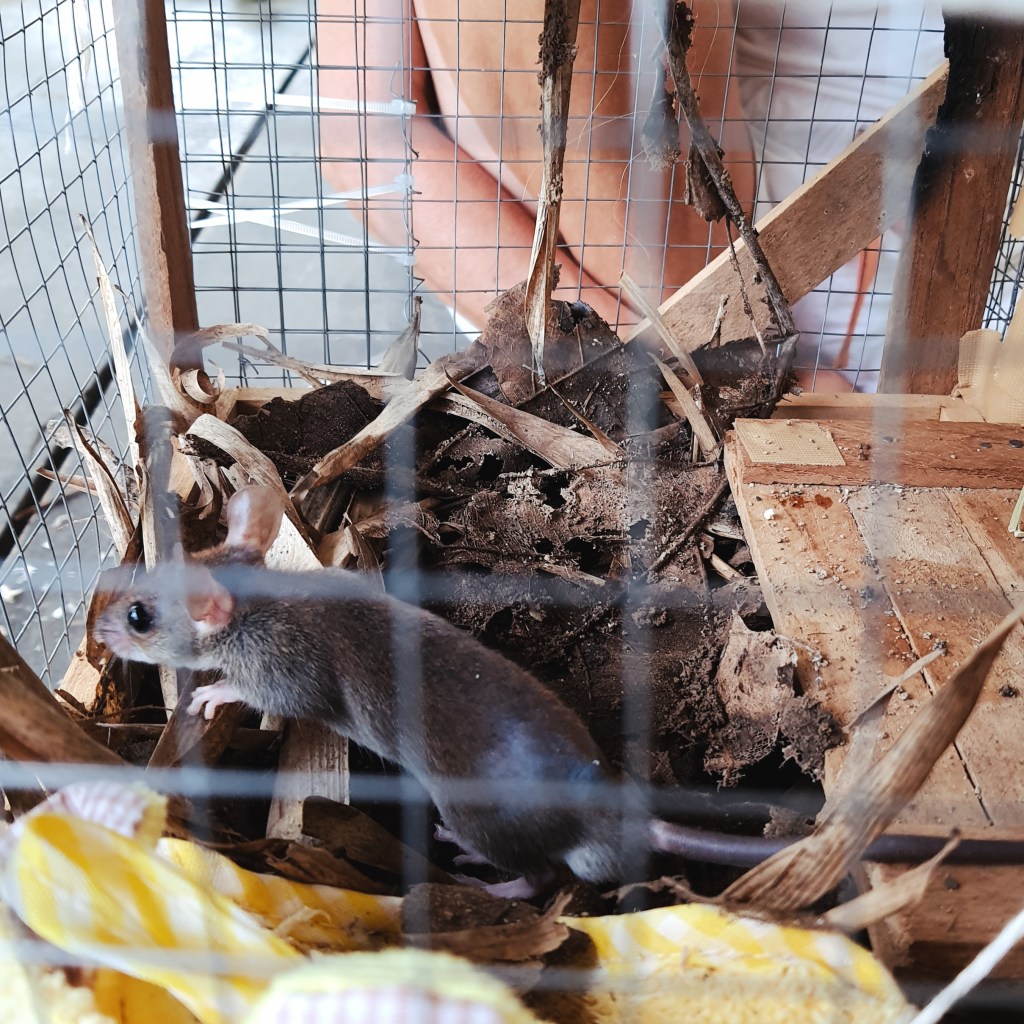
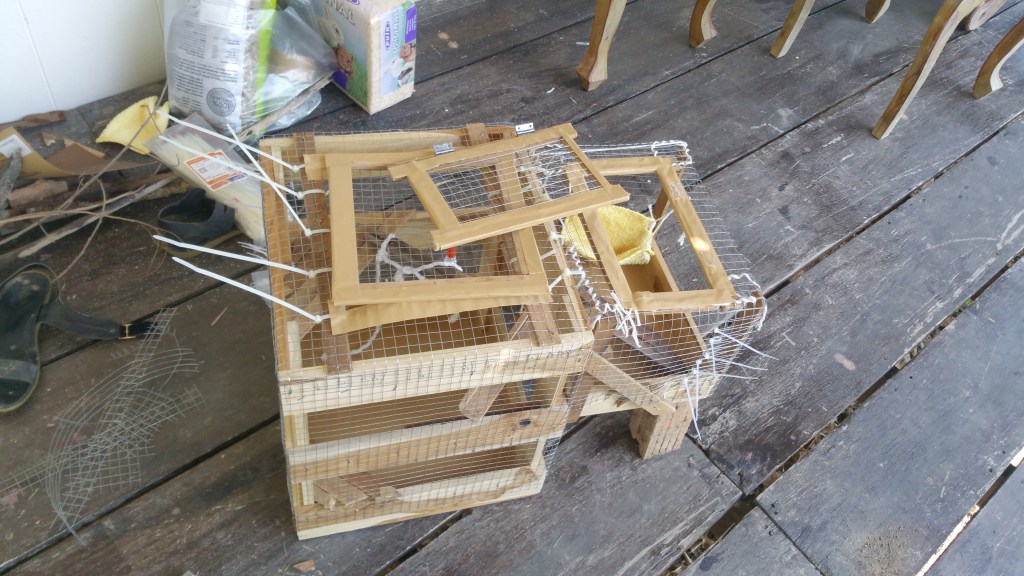
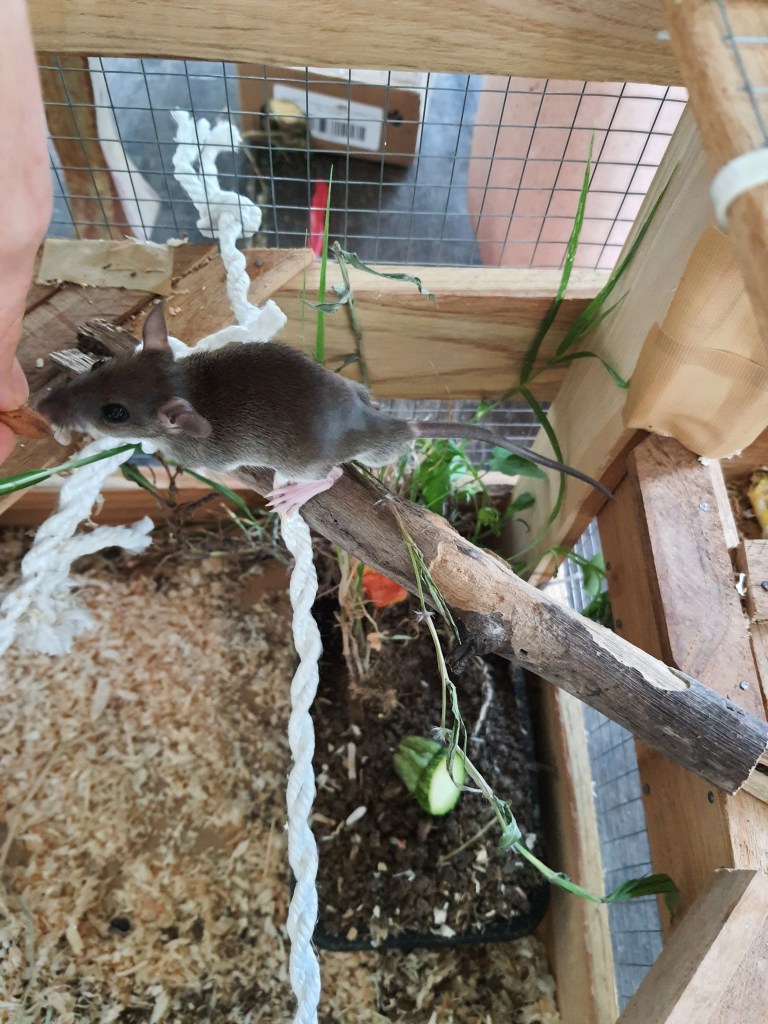
    Until their eyes opened I kept them in a medium sized cardboard box with bedding and a hot water bottle. During this time I worked on building a cage for them. I tried to make it as exciting as possible so they could practice climbing and jumping, as well as walking along unstable surfaces. I lined the floors of the cage with duck tape to avoid Ratty’s urine soaking into the wood and covered it with saw dust, occasionally also adding barks, leaves and grass from the garden. If you opt to buy a cage you’ll want to choose metal over plastic as plastic can be chewed through.

    I added various, homemade toys to place in their cage to keep them entertained with a digging pit being the greatest success. Other games involved hiding their food under rocks or bark, or inside stuffed toys, or hanging their food where some problem solving was required to get to it. A list of inexpensive rat toys can be found here.
    7. Helping your kittens leave their nest (and you).

    With the aim of releasing Ratty at week 6, I introduced him to more and more items from the garden including leaves, stones, insects (if I could find them) and I would also provide him with a tray of soil and grass which he could dig in. Digging was by far one of his favorite activities and if there were insects or seeds hidden in there, even better.

    His releasing happened very naturally when one day as I was cleaning out his cage in the garden, he managed to pull himself out of the top hatch. I allowed him to decide what he would do next, which was to jump back inside the box. A short while after he managed it again, this time climbing down the outside of the cage and running to the nearest shelter in the garden. This happened in the late afternoon when I found him to be most active after sleeping mostly during the day. He spent roughly one hour exploring a small area of the garden and still interacted with us. We were still able to touch him and pick him up however we chose to leave him free, with access to his cage and food if he wanted it. After leaving him sheltering under a plant pot with a couple of fleece blanket cuttings and food that was the last we saw of him for about 2 weeks. Since then he regularly visits our bird table for snacks. It was a wonderful experience caring for him and it was with a selfishly, heavy heart that I released him.

    8. Don’t be hard on yourself if they don’t make it.

    Lastly, understand that death is a part of life. If despite your valiant efforts they don’t make it, take solace in the experience you shared of providing kindness and compassion. Your life and theirs will have been greatly enriched.

    9. Helpful links.

    I found the below articles and blogs to be helpful in terms of caring for baby rats.

    http://www.ratfanclub.org/orphans.html
    http://www.rmca.org/Articles/orphans.htm

    https://pethelpful.com/rodents/homemade-rat-cages-and-toys

  • Understanding Death: A Journey Through Eastern and Western Views

    Understanding Death: A Journey Through Eastern and Western Views

    Around 3 weeks ago I found two, wild, rat kittens lying on a path whilst birds swooped down and pecked at them, not to eat but to eliminate a perceived threat.  It was apparent that the modeling of these particular bird brains did not allow them to discern the different levels of threat between a baby and adult rat, only that all rats are a threat.  At first I couldn’t make out what lay on the path, I walked over to find a little body laying there with eyes still firmly closed and a cut to the side of it’s abdomen in the shape of a bird peak.  I instinctively picked him up. A little way to the side lay his brother with a bigger cut to his head.  I carried them around in my hands for a while, attempting to keep them warm whilst trying to decipher where they’d come from and was there any possibility of returning them to their nest.  With the threat of birds overhead it wasn’t feasible to leave them on the path for their mother to retrieve them.  Unfortunately no nest could be located so I took them in and spent the next two weeks nursing them first with baby formula and then gradually weaning them onto solid foods.  Gradually their eyes and ears opened and they began exploring their purpose-built cage to house them until they were old enough to be released back into the wild.  What I found most surprising was the distance and speed they moved at when still totally blind, as though they were simply too impatient to wait for their eyes to open and would get on with exploring anyhow.  Perhaps they were precocious learners.

    At the 3 week mark, it seemed like we had made it. They were fully weaned, growing in size, and were far more balanced with their movements. And yet, Pip’s breathing had changed.  Each time he breathed in he produced a clicking sound and his breathing rate was ever so fast.  He had pulled himself out of his nest box one morning and was laying in what I would have considered too exposed an area for a rat and everything about his behaviour was muted and diminished.  By the late afternoon he had passed away.

    I had the rare opportunity of holding him in my hands during the final couple of hours. I witnessed the transition from life into death. This experience raised several questions in myself both during and after the event.  Would it be right to interfere with the process and take him to a vet to “save” his life?  What is the relevance of his body once he’s died and where is “he” now?

    Should I have attempted to “save” Pip with medical intervention?

    The answer to this question depends very much on which culture you have been raised in. It also depends on what your belief system is.  For simplicity’s sake, I will define the West as containing the Christian, Muslim, and Judaism faiths. The East includes Buddhism, Taoism, Hinduism, Jainism, etc.

    The Western faiths believe that there is only one life. Once you die, you head either to heaven or hell. This belief gives you two options of living. You can make the most of it, as time is running out. Alternatively, you can rely on Heaven as the ultimate goal. It is viewed as an everlasting life. This makes what happens on Earth seem irrelevant.  The East believes something very different. They believe you have infinite lives. You are constantly reborn once one life has ended. This cycle continues to increase your level of consciousness until you reach enlightenment and return to the Source.  In the West, religion has been steadily declining. What’s interesting is that even if you’re an atheist with a strong disdain for religion, you have been socially conditioned. You still believe there is only one life. This is because religion is so deeply embedded in our societies.  This permeates deeply through all levels of our behaviour, so imagine how differently you might behave if you not only believed but knew that your life force/energy/soul was brought back into a living body after each death.  Perhaps life wouldn’t be such a rush to reach the top, feeling like time was always running out; perhaps you wouldn’t be filled with anxiety of having to achieve things earlier in life in order to have time and money to enjoy and experience things as you age.  What about your job? What about your body? Think about your responsibilities. How do these all change when you consider that perhaps there isn’t one life only for each of us? #YOLO (You Only Live Once) sounds like a pretty ridiculous handle but an unfortunate representation of how people can and do behave with that belief system.  For those unfamiliar with #YOLO, it is an abbreviation used for behaving recklessly under the assumption that you only live once so should make the most out of life, whether it’s binge drinking and drug sessions, unprotected sex, dangerous stunts, you get the drift.

    Osho very succinctly puts into words our Western social conditioning on death.

    “We have been taught for centuries that death is against life, that death is the enemy of life, that death is the end of life.  Of course, we are scared and cannot relax, cannot be in a let-go.  And if you cannot be in a let-go with death, you will remain tense in your life, because death is not separate from life.”

    To speak of death in the West in terms other than how to increase longevity and achieve immortality is seen as taboo, perverse, religious or spiritual nonsense or farcical, such is the fear and lack of understanding of it.  My experience with Pip and my own personal exploration into Eastern philosophy and the Buddhist understanding of the mind has led me to question the truth of a “one life only” paradigm.  At this stage I am still full of questions and so the idea that your life force is reseeded in another body is still something to be further explored, to find my own understanding and experience this for myself by way of meditation, yet I have a strong sense of knowing that I’m on the right path.

    My exploration into all of this led me onto something really interesting on how we have been socially conditioned to believe in either one life or many.

    Jesus, Mohammed, Buddha, Krishna, etc.  were all great teachers of their times and the manner in which they shared their teachings was dependent upon the social behaviours of their societies in their eras and regions.  It’s worth noting that religions did not attach themselves to their teachings until after their deaths, in the case of Buddha, some 500 years after his death and one should therefore be careful not to confuse religious dogma and agenda with the pure teachings of these men.  In the case of the Eastern teachers they had known for thousands of years that reincarnation was true, it wasn’t only a theory that was taught but had anecdotal evidence to support it.  Jesus and Moses were known to have traveled to India and would have therefore come across these teachings and evidence and yet upon their return to the West they didn’t share this with their disciples.  The reason was that they had noted how the theory of reincarnation had made the Indians very lethargic in life; when you know you will have multiple lives, what is the rush in doing anything.  This wasn’t the case though when Buddha and Krishna originally shared their teachings hundreds of years previously, in fact, India was a rich country then with very bored people, so they painted a picture of having to live with the same boredom life after life, whipping people into shape and encouraging them to pursue meditation and enlightenment.  But then India entered into a period of poverty, still grasping on the theory of reincarnation, they now found themselves hoping for an escape in their next life.  This life hasn’t worked out, maybe the next one will.   This escapism resulted in avoidance of living to the fullest and the postponement of living.  Jesus and Moses saw this and realised the strategy was no longer working, so on their return to the West they shared a different story, one where you only have one life so if you want to enlighten, if you want to meditate, do it now, don’t put it off till tomorrow, time is ticking.  And it is through this mechanism that the West has now become pathological with it’s concept of time and linear living.  Just like with Buddha and Krishna, Jesus, Mohammed and Moses’ teachings worked for the era that they lived but there comes a time when the framework of society shifts and holding onto old teachings can be detrimental.  It is for this reason that you shouldn’t accept any belief you hold without having first questioned it fully.

    To take this back to the question then of whether medical intervention was necessary depends, partly, on how strongly you believe in one life vs many.  In the West it seems now more than ever that we cannot accept that people die, everyone must be saved and strong, violence-based terms are used to combat, attack, fight, destroy illnesses or diseases as though death is the enemy rather than a natural process.  It is as though people have forgotten that we are nature and nature can end this life at any time.  As such, people are not dying naturally at home like they might have done only some 150 years ago but instead make frequent hospital trips for intensive and extensive treatment up to the day they die.  Personally this sounds incredibly stressful and a fight to avoid death means  fear will hold strong in those final moments, dying at home or in nature is the way I want to go.

    I recall a news report a few years back in Australia of a young man who died as a result of a shark attack when he was out surfing.  As he was sat on his board with his legs dangling over the sides, a sizeable shark bit his legs.  His friends around him went to grab him and pull him ashore and uncharacteristically the shark didn’t let go as they normally would when making an error in food source.  There was a tug of war and eventually the shark swam off, leaving the friends to pull the young man ashore.  On the beach it was evident he’d lost at least one of his legs and was bleeding profusely. All of this sounds horrific, like a scene of out Jaws (a film that plays our your fear of dying violently) and yet his friends recounted that he was totally calm and asked that they pass along his love to his loved ones before dying.  It was highly likely that his body had responded to the shock of the attack preventing him from feeling pain and allowing him to peacefully move on which in one sense was perfect.  It was those that had witnessed the event that most likely suffered the worst of it and without the wisdom of an elder it will only reinforce that death is something to be feared.

    I should probably make it clear that I do believe in medical intervention, however there is a fine line between knowing when to let go and when you are simply avoiding dying out of fear of death and I think the ease of finding this line can only be put down to how enlightened both the person dying is as well as the person caring for them.  Having said this if you live a life close to nature following it’s natural rhythms with a healthy attitude towards death, there shouldn’t be too much opportunity for medical intervention as you lead a life of preventative care.

    Does your body make you you?

    Imagine for a moment that the essence, the life force, the soul, whichever term you feel is relevant, of your loved one was moved out of their body and into another and into their body was placed another life force.  Which body would you feel that same connection to, would it be the body that looks like them, or the body that contains their energy, their personality, behavioural patterns etc?

    In the process of Pip passing away in my hands, his breathing became slower and slower until finally he breathed in but didn’t breathe out again.  Almost instantly he became unrecognisable, something drastically had changed and yet all the identifiable features of his body remained.  The scar of the bird beak on his head was still there.  Yet after that moment of dying his body was that of any rat which lead me to truly knowing that his body wasn’t HIM, it was merely a meat suit or a shell that housed his true essence.  What that true essence is though I know only to describe as his energy force which vibrated at a specific frequency, a fingerprint unique to him.

    On a basic level your body is little more than an assimilation of memory based around the framework of a genetic blueprint heralding back from all your ancestors and evolutionary history (more than a few terabytes of data there.) As you operate your body through life it picks up more memory through the environments you expose it to, the substances it consumes, the knowledge it acquires and then should you have offspring, this memory is passed on through genetics.  I am not suggesting that you should disregard your body as little more than a vessel, in fact, I am of the view that the body should be well looked after with and understanding of how to maintain homeostatic internal process through allostasis and that through doing this you can use your body to further your process of enlightenment, however it is not to believe that your body IS you.

    So if your body doesn’t make you you, then what does and if you’ve spent your life defining yourself by your appearance how will this affect you?

    This requires an even deeper dive into a fundamental understanding of the mind and the Eastern philosophies that I shall perhaps cover in another blog if anyone is interested.  However if I mention something in short, it would be that the ultimate goal is to achieve enlightenment, in doing so you free yourself from the Earthly realm.  To go about achieving enlightenment is to basically work through your issues.  Every single thing you think you know about yourself needs to be overturned and examined and by doing this you slowly rid yourself of your conditioned beliefs, your angry outbursts, your patterns of cheating on your partner, your need to consume alcohol to get through life etc.  Every time you rid yourself of one of these patterns you’ve taken a step closer to enlightenment.  My understanding is that during each lifetime, you work through as much as you can and when you’re reborn in your next life you start from where you left off.  Therefore if you spend a lifetime believing you are your body you have in one sense wasted a life and will be born at the same level of consciousness that you died, finding yourself in an endless loop of suffering.

    And so I find that little Pip who only graced my life for two short weeks has helped me shape my views on dying and living, perhaps I’ll meet him again.

    This blog is not force you to believe anything different to what you already know and understand but to have you question those beliefs and to question how you’ve come to believe what you believe –  has it been through personal enquiry or because “that’s what I’ve always known”, and therefore, social conditioning?

    “It’s an absolute certain fact that people die, animals die, trees die, birds die.  How can you avoid the fact that you are also going to die – maybe tomorrow, maybe the day after tomorrow?  It is only a question of time.  But still, those who are aware of their being know that nobody dies.  Death is an illusion”.  Osho, Death: The Greatest Fiction.

    Thank you for taking the time to read my blog.  If you found it interesting, please like and subscribe and drop a comment below too as it helps the algorithm immensely.